Short Answer
Cut flowers are among the world’s most valuable horticultural commodities, generating billions of dollars in trade each year. Yet, moving a bouquet from a greenhouse in Kenya to a retailer in the United States involves more than a box and a cold chain; it requires strict compliance with international phytosanitary standards. This article consolidates the core requirements—certificates, treatments, inspections, and documentation—into one reference point for exporters, importers, customs brokers, freight forwarders, and agriculture students who need fast, reliable answers.
Overview
Cut flower export requirements are the set of rules that govern the safe, legal movement of ornamental plant parts across international borders. They are designed to prevent the introduction of pests and diseases while ensuring that trade flows efficiently. The framework is built on the International Plant Protection Convention (IPPC) and its International Standards for Phytosanitary Measures (ISPMs), which each National Plant Protection Organization (NPPO) implements in national legislation.
- Scope: Whole stems, bouquets, and potted ornamental foliage that are intended for consumption as cut flowers.
- Key Goal: Provide a phytosanitary certificate (PC) that confirms the consignment is free of regulated pests and meets treatment standards.
- Typical Path: Grower → Local NPPO inspection → Export Phytosanitary Certificate → Freight forwarder → Import NPPO clearance → Retail.
Why it Matters (Real Stakes for Exporters/Importers)
Non‑compliance can cripple a business. The most common consequences include:
- Shipment rejection: Border officials may seize or return the cargo, causing loss of product freshness.
- Financial penalties: Fines range from a few hundred to several thousand USD per consignment.
- Reputational damage: Repeated rejections erode trust with retailers and end‑users.
- Regulatory sanctions: In severe cases, exporters can be placed on a prohibited list, barring future trade.
Conversely, a well‑documented export process reduces clearance times, improves market access, and can be a competitive advantage.
Regulatory Authority & Contact
The primary bodies overseeing cut flower trade are:
| Authority | Role | Typical Contact Point |
|---|---|---|
| International Plant Protection Convention (IPPC) | Sets global standards (ISPMs) | Secretariat, FAO – ippc.fao.org |
| National Plant Protection Organization (NPPO) – Exporting Country | Issues phytosanitary certificates, conducts inspections | Country‑specific plant health agency (e.g., Kenya Plant Health Inspectorate Service) |
| NPPO – Importing Country | Reviews certificates, may require additional treatment | Import authority (e.g., USDA‑APHIS Plant Protection and Quarantine) |
Exporters should keep a current contact list for both the exporting and importing NPPOs, including phone numbers, email addresses, and the name of the officer responsible for ornamental plants.
Import/Export Procedure
Below is the typical flow for a cut‑flower shipment:
- Pre‑export verification: Confirm that the destination country permits the specific flower species and variety.
- Pre‑treatment: Apply any required hot water treatment (HWT), cold treatment, or fumigation as stipulated by the importing NPPO.
- Inspection & certification: An authorized NPPO inspector examines the consignment and issues a Phytosanitary Certificate (PC) that references the relevant ISPM (e.g., ISPM 15 for wood packaging, ISPM 36 for pest‑free areas).
- Packaging compliance: Use approved, pest‑free packing material (e.g., ISPM 15‑certified pallets).
- Freight forwarding: Submit the PC and commercial invoice to the carrier; ensure temperature control documentation is attached.
- Import clearance: The importing NPPO reviews the PC, may conduct a spot inspection, and releases the cargo.
- Post‑arrival handling: Retailers must store flowers at the recommended temperature and humidity to preserve quality.
Required Documents
The following documents are typically mandatory for every cut‑flower export:
- Phytosanitary Certificate (PC): Issued by the exporting NPPO, must include commodity description, origin, treatment details, and reference to the applicable ISPM.
- Commercial Invoice: Shows value, HS code (e.g., 0602 10 for cut roses), and consignee details.
- Packing List: Itemizes each container, quantity, and packaging type.
- Certificate of Origin (CO): Required for preferential tariff treatment in some markets.
- Fumigation/Treatment Certificate: If HWT, cold treatment, or pesticide application is used.
- Import Permit: Some countries (e.g., USA, EU) require an import permit before arrival.
All documents must be in the language accepted by the importing NPPO (often English, French, or the local language) and should be presented in original form or as a certified electronic copy where permitted.
Requirements & Standards (Cite Primary Source: IPPC/NPPO)
The core standards governing cut‑flower exports are:
“ISPM 15 – Regulation of wood packaging material – requires heat treatment or methyl bromide fumigation and a standardized IPPC mark on all pallets and crates. (FAO, 2022)”
“ISPM 36 – Guidelines for the import of ornamental plants – outlines pest‑free area (PFA) certificates, treatment protocols, and inspection frequencies. (FAO, 2021)”
National NPPOs adopt these ISPMs into their legislation. For example, the United States Department of Agriculture (USDA‑APHIS) references ISPM 15 in 7 CFR 319.56‑1 and requires a Phytosanitary Certificate that cites ISPM 36 for ornamental cut flowers.
Key compliance points:
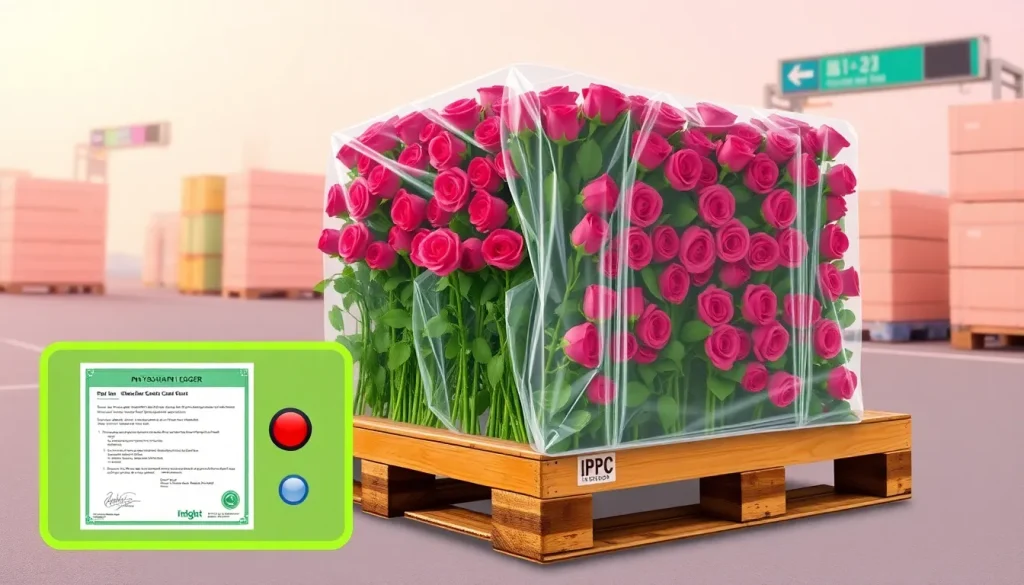
- All wooden pallets must carry the IPPC mark (heat‑treated “HT” or fumigated “MB”).
- Hot water treatment for roses: 53 °C for 30 minutes, followed by rapid cooling.
- Residual pesticide limits must comply with the Maximum Residue Limit (MRL) of the importing country.
- Any regulated pest detected during inspection must be declared, and the consignment may be required to undergo additional treatment or be rejected.
Step‑by‑Step Checklist (How‑to Trigger Export)
- Identify market entry requirements: Use the IPPC Trade Helpdesk or the importing NPPO website to confirm allowed species and treatment codes.
- Prepare the grow‑out area: Implement Integrated Pest Management (IPM) to keep pest incidence below the threshold defined in ISPM 36.
- Schedule pre‑export inspection: Contact the local NPPO at least 7 days before shipment to arrange a certified inspector.
- Apply required treatment: Conduct HWT, cold treatment, or fumigation; retain temperature logs.
- Package using ISPM‑15‑approved pallets: Verify the IPPC mark is visible on all wood packaging.
- Obtain Phytosanitary Certificate: Ensure the PC lists:
- Scientific name (e.g., Rosa hybrida)
- Quantity and packaging description
- Treatment details (e.g., HWT 53 °C/30 min)
- Reference to ISPM 15 and ISPM 36
- Compile export documents: Invoice, packing list, CO, import permit (if required).
- Book temperature‑controlled freight: Provide the carrier with a cold‑chain monitoring plan.
- Submit documents to the carrier: Include electronic copies for customs pre‑clearance.
- Post‑arrival follow‑up: Confirm receipt of the PC by the importing NPPO and address any queries within 48 hours.
Common Mistakes & Rejection Reasons
Even seasoned exporters stumble over a few recurring pitfalls:
- Missing or inaccurate IPPC mark: Leads to immediate detention under ISPM 15.
- Incorrect treatment records: Temperature logs that do not match the PC raise red flags.
- Use of non‑certified packaging material: Plastic wraps that conceal pests are prohibited.
- Failure to declare regulated pests: Undeclared insect larvae or fungal symptoms result in rejection and possible quarantine.
- Out‑of‑date phytosanitary certificate: PCs are typically valid for 30 days; older certificates are rejected.
Mitigation strategies include double‑checking the PC details, maintaining a treatment logbook, and conducting a pre‑shipment internal audit.
Real‑World Example/Scenario
Scenario: A Kenyan exporter ships 5 tons of cut roses to the United States.
- The exporter verifies that the USDA‑APHIS requires HWT at 53 °C for 30 min and ISPM 15‑certified pallets.
- After treatment, the exporter records temperature data on a calibrated data logger.
- An NPPO inspector issues a Phytosanitary Certificate referencing ISPM 36 (PFA) and ISPM 15 (HT pallets).
- The freight forwarder loads the roses onto a refrigerated container (2 °C) and submits the PC, invoice, and import permit to U.S. Customs.
- U.S. APHIS conducts a spot inspection, finds the IPPC marks intact and the temperature log matching the PC, and releases the cargo.
- Retailers receive fresh, pest‑free roses, and the exporter enjoys a repeat‑order incentive.
If the exporter had omitted the IPPC mark, the shipment would have been detained at the port of entry, resulting in a loss of product quality and a $5,000 penalty.
Conclusion
Cut flower export requirements are a blend of international standards, national regulations, and practical on‑the‑ground measures. By understanding the why, what, and how of phytosanitary compliance—especially the roles of the IPPC, ISPM 15, and ISPM 36—exporters can avoid costly rejections, protect global plant health, and keep their bouquets blooming all the way to the consumer.
FAQ
Do all cut flowers require hot water treatment?
Only species listed by the importing NPPO as needing HWT must receive it. Roses, carnations, and lilies often require HWT; others may be cleared with inspection only.
Can I use plastic pallets instead of wood?
Yes, provided the plastic pallets are clean, free of soil, and meet the importing country's packaging standards. Plastic pallets eliminate the need for ISPM 15 marking.
How long before shipment should I request a phytosanitary certificate?
Schedule the inspection at least 7 days prior to departure to allow time for treatment, documentation, and any corrective actions if pests are found.




Leave a Reply