Short Answer
Quick definition
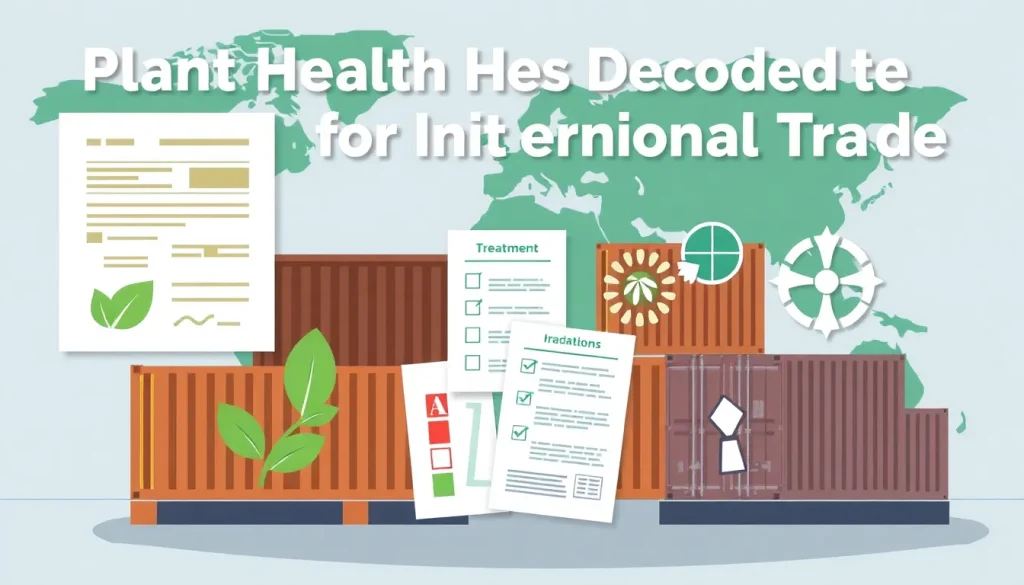
Phytosanitary treatments are methods used to disinfest or disinfect plant commodities of regulated pests. <cite index=”173-1″>ISPM 28 specifies phytosanitary treatments for regulated pests, including mechanical, chemical, irradiation, physical (heat, cold) and controlled atmosphere treatments.</cite> Each treatment works differently — fumigation uses gas to kill pests, heat treatment kills pests via temperature stress, cold treatment immobilizes or kills cold-susceptible pests, and irradiation damages insects’ reproductive systems. <cite index=”177-1″>At the doses used for phytosanitary irradiation (70 to 400 Gy), more fresh fruits and vegetables tolerate radiation than any other broadly applicable commercial treatment.</cite> Different commodities and different pests require different treatments, and each has trade-offs in cost, speed, effectiveness, and impact on fruit quality.
Overview
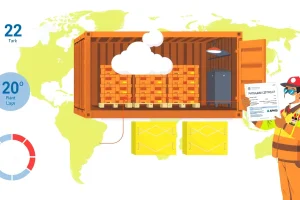
Pest risk doesn’t end at the exporting country’s border. A phytosanitary certificate guarantees that a lot was inspected and found free of pests at the time of inspection. But during shipping — a journey lasting 2–4 weeks by sea — a single surviving pest could reproduce and establish. To eliminate this risk entirely, many importing countries require treatment in addition to certification.
A treatment is a controlled process that kills, immobilizes, or removes pests from a commodity. It’s insurance: if a few insects somehow escaped inspection, the treatment ensures they won’t make it to the destination. Different pests die at different temperatures, different fruits tolerate different treatments, and different countries recognize different treatments as adequate.
For an exporter, understanding treatments is essential because an importing country’s phytosanitary requirements often specify which treatments are acceptable for which pests on which commodities. Know the requirement, find or arrange the treatment facility, complete the treatment with documentation, include proof of treatment in the phytosanitary certificate, and export. Without this sequence, goods will be rejected or destroyed.
Why it matters
A single Bactrocera dorsalis (Oriental fruit fly) larva hidden inside an exported mango can establish a breeding population in a fruit-growing region of the importing country, causing millions in crop damage. Importing countries cannot take that risk. So they require either:
- A pest-free area certification (proving the pest doesn’t exist in the origin region)
- Pre-shipment treatment
- Both
For Indonesian exporters, Option 2 is most common: grow the fruit in a region where the pest exists, treat the fruit before export, and ship with proof of treatment. <cite index=”168-1″>Indonesia’s phytosanitary regulations accept fumigation, vapor heat treatment (VHT), irradiation, and in-transit cold treatment for fresh fruits and vegetables infested with regulated quarantine fruit flies.</cite>
The economics are significant. A vapor heat treatment adds 2–5 days and USD 500–1,500 per container. Irradiation adds USD 800–2,000 per container but no time. Cold treatment requires refrigerated shipping, adding cost and limiting shelf life for tropical fruit. Methyl bromide fumigation costs USD 300–800 but is increasingly restricted. Exporters must choose or negotiate the most feasible treatment that meets market requirements.
The four major phytosanitary treatments
1. Fumigation (chemical vapor)
Primary fumigant: Methyl bromide (MB)
<cite index=”170-1″>Methyl bromide is being phased out internationally under the Montreal Protocol, though quarantine and pre-shipment (QPS) exemptions allow continued use for government-required quarantine treatment to prevent the spread of regulated exotic pests.</cite> <cite index=”171-1″>MB is considered ozone-depleting and the Montreal Protocol, along with the U.S. Clean Air Act, aims to phase out production and consumption, with exemptions only for critical uses including quarantine and pre-shipment applications.</cite>
How it works: MB is a colorless, odorless gas. Commodities are sealed in a chamber or under a tent, MB is injected, the gas penetrates packed fruit, kills insects by disrupting their nervous systems, and is then vented or recovered. No residue remains on the fruit.
Efficacy: Broad-spectrum — kills eggs, larvae, pupae, and adults of most insects. Highly effective against fruit flies, wood-boring beetles, and other quarantine pests.
Temperature/dosage: Typically 20–40 g/m³ for 2–24 hours, depending on commodity and target pest. Temperature must be ≥21°C (warmer = faster). <cite index=”175-1″>MB fumigation effectiveness is confirmed when the specific concentration of fumigant, at the minimum temperature and duration required for the stated efficacy, is achieved in the area of lowest concentration within a fumigation enclosure.</cite>
Time: 2–24 hours for treatment + 24–48 hours for aeration and documentation = 2–3 days total.
Cost: USD 300–800 per 20-foot container, depending on commodity and region.
Limitations:
- Phasing out due to ozone-layer concerns (Montreal Protocol phase-out target ~2030 for developed nations; exemptions still granted for QPS)
- EU has already banned MB for non-critical uses; some importers no longer accept it
- Requires certified facilities and safety protocols
- Cannot be used on certain commodities (e.g., some ornamentals)
Modern alternatives: Sulfuryl fluoride (SF), phosphine, and CO₂-based fumigants are being tested and approved as ISPM 28 treatments, but none yet equals MB’s broad-spectrum effectiveness. <cite index=”172-1″>Methyl bromide is considered the only quarantine fumigant available currently that is internationally accepted for general use, though alternatives to methyl bromide for use as phytosanitary measures are needed, particularly because of future restrictions on the use of methyl bromide.</cite>
2. Vapor Heat Treatment (VHT) — Heat method
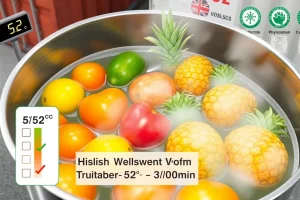
How it works: Commodities (usually fruit) are loaded into a chamber with controlled hot air and high humidity (near 100% RH). Temperature is gradually raised to a target core temperature (the fruit’s center), held for a specified time, then gradually cooled.
Pest susceptibility: Highly effective against fruit flies (Tephritidae), especially eggs and early-stage larvae. Adult flies and late-instar larvae are more heat-tolerant, so the protocol must account for these harder-to-kill stages.
Temperature/time protocols (selected examples per ISPM 28):
| Commodity | Pest | Core temp | Hold time | Total time |
|---|---|---|---|---|
| Papaya | Bactrocera dorsalis (Oriental fruit fly) | 47.2°C | 0 min | ~3 hours ramp-up |
| Mango | Bactrocera spp. | 46.5°C | 20–30 min | ~2–3 hours total |
| Guava | Bactrocera dorsalis | 47.5°C | 25 min | ~2.5 hours total |
<cite index=”181-1,182-1″>Vapor heat treatment for papaya infested with oriental fruit fly requires heating to a core temperature of 47.2°C with a heating rate of 0.0925°C/min, achieving 100% mortality of all life stages including eggs. Mango varieties treated at 46.5°C for 20–30 minutes showed effective control with no significant changes in fruit quality including weight, color, hardness, or vitamin C content.</cite>
Time: 2–4 hours for treatment + 1–2 days for loading/unloading/documentation = 1–2 days total.
Cost: USD 500–1,500 per 20-foot container, depending on facility and commodity.
Advantages:
- No chemical residue
- Maintains fruit quality well (minimal weight loss, color retention)
- Widely accepted internationally
- Facility can process multiple containers in sequence
Disadvantages:
- Slow come-up time (especially for large, thick-skinned fruit like mango)
- Infrastructure limited in Indonesia — few VHT facilities outside Java
- High capital cost for facility (USD 500K–2M per chamber)
- Cannot treat all commodity types (delicate fruit, ornamentals at risk of damage)
Indonesia availability: Some commercial VHT facilities exist (particularly for mango and papaya export), but capacity is limited. Most facilities are in major export hubs (Jakarta region, Surabaya). <cite index=”168-1″>Indonesia’s phytosanitary regulations recognize VHT as an approved pre-shipment treatment for fresh fruit and vegetables infested with regulated fruit flies.</cite>
3. Cold Treatment
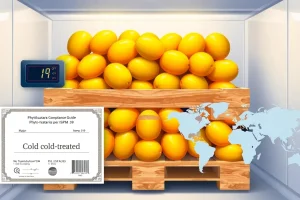
How it works: Commodities are held at precisely controlled low temperatures (typically 0–3°C) for an extended period. Low temperature slows pest metabolism, disrupts reproduction, and eventually causes death. Most effective against Mediterranean fruit fly (Medfly, Ceratitis capitata) and Queensland fruit fly (Bactrocera tryoni).
Pest susceptibility: Highly effective against Ceratitis capitata and Bactrocera tryoni on citrus and other fruit. Less effective or not approved for Oriental fruit fly (Bactrocera dorsalis), which tolerates cold better. <cite index=”183-1″>Cold treatment at 0–2°C for 18 days is lethal to Mediterranean fruit fly at a rate exceeding 99.9968% confidence level with 99% certainty; third-instar larvae are the most cold-tolerant stage, requiring 7–8 days at 3°C for 99.9% mortality.</cite>
Temperature/time protocols (per ISPM 28 approved treatments):
| Fruit | Pest | Temperature | Duration | Efficacy |
|---|---|---|---|---|
| Citrus sinensis (orange) | Ceratitis capitata | 2°C or below | 18 days | 99.9937% |
| Kiwifruit | Ceratitis capitata | 3 ± 0.5°C | 18 days | 99.9968% |
| Citrus reticulata (mandarin) | Bactrocera tryoni | 2°C or below | 18 days | 99.9986% |
<cite index=”184-1″>Maximum fruit core temperature must be kept at 2°C or below for 18 continuous days, with fruit temperature monitored and recorded, for approved cold treatment of citrus against Mediterranean fruit fly.</cite>
Time: 18–24 days (depending on protocol and commodity ripeness) + 1–2 days for loading/shipping setup = ~3 weeks total.
Cost: Variable — cost is primarily shipping/logistics (refrigerated container + extra shipping time). Equipment cost is USD 200–400 per 20-foot container; if done in-transit, cost may be absorbed in shipping.
Advantages:
- No chemical residue
- Excellent for preserving fruit quality (maintains firmness, color, flavor)
- Can be done in-transit (no facility needed)
- Accepted globally for citrus and compatible fruit
Disadvantages:
- Very long duration (18+ days) — incompatible with highly perishable tropical fruit (mango, papaya ripen and decay at this temperature)
- High ethylene/ripening issues
- Requires continuous temperature monitoring and documentation
- Not effective for Oriental fruit fly (the most common pest in Indonesia)
Indonesia availability: Cold storage infrastructure exists but is primarily for generic refrigeration, not phytosanitary cold treatment. Few facilities specialize in maintaining the precise 2°C ± 0.5°C required. In-transit cold treatment is possible but extends shipping time — impractical for rapid-spoiling tropical fruit.
4. Irradiation (Gamma rays)
How it works: Commodities are exposed to ionizing radiation (gamma rays from Cobalt-60, Cesium-137, or X-rays) at controlled doses measured in Gray (Gy). Radiation damages insects’ reproductive systems, causing sterility or developmental arrest; insects cannot reach the adult stage. No chemicals used; commodities are not radioactive after treatment.
Pest susceptibility: Highly effective against fruit flies, moths, beetles, and most insect pests. Different pests require different doses.
Dose protocols (per ISPM 28 and ISPM 18):
| Pest group | Minimum dose | Commodity examples |
|---|---|---|
| Anastrepha spp. (South American fruit flies) | 70 Gy | Fruits (hosts of A. ludens, A. fraterculus) |
| Bactrocera dorsalis (Oriental fruit fly) — preliminary | ~250 Gy | Mango, papaya, guava |
| Ceratitis capitata (Mediterranean fruit fly) | 100 Gy | Citrus, other fruit |
| Generic Tephritidae (fruit flies) | 150 Gy | Most fruit |
| Generic insects (except Lepidoptera pupae/adults) | 400 Gy | All commodities |
<cite index=”186-1,187-1″>Irradiation at 70 Gy prevents emergence of adult Anastrepha at 99.9968% efficacy; US, Australia, and New Zealand have adopted generic doses of 150 Gy for tephritid fruit flies and 400 Gy for all other insects (except Lepidopteran pupae/adults) on all hosts.</cite> <cite index=”189-1″>For irradiation treatment, dosimetry systems are used by facilities to determine absorbed dose; irradiation is considered effective when the specific radiation dose, at the minimum level required for stated efficacy, is achieved in the area of lowest dose within the irradiation chamber.</cite>
Time: 2–4 hours for treatment + 1–2 days for loading/documentation = 1–2 days total.
Cost: USD 800–2,000 per 20-foot container (depending on dose and facility utilization).
Advantages:
- Fast (minimal delay to shipment)
- No chemical residue
- Excellent fruit quality preservation
- Generic doses available for broad pest groups (one dose = multiple pests)
- Widely accepted in major markets (USA, Australia, Japan, most of Asia)
Disadvantages:
- Limited facility availability, especially in developing nations
- High capital cost (USD 3–10M per facility)
- Regulatory acceptance varies by country (EU skeptical; Japan accepting for specific commodities)
- Labeling required in some markets (radioactivity disclosure)
- Perceived consumer resistance in some regions (though scientifically safe)
Indonesia availability: Limited. <cite index=”175-1,176-1″>Indonesia’s food irradiation market is forecast to grow from USD 12–18 million in 2026 to USD 30–45 million by 2035, with volume throughput increasing from 5,000–8,000 metric tons per year to 15,000–25,000 metric tons per year, assuming expansion of at least one new facility; regulatory environment is gradually improving with updated guidance documents from Badan POM (Food and Drug Authority) in 2024–2025.</cite> As of mid-2026, only a handful of commercial irradiation facilities operate in Indonesia, mostly for spices. Fruit irradiation infrastructure is in early development phase.
Comparison table: When to use each treatment
| Treatment | Best for | Speed | Cost | Quality | Infrastructure | Market acceptance |
|---|---|---|---|---|---|---|
| Fumigation (MB) | Broad-spectrum pest control; wood products | 2–3 days | Low (USD 300–800) | Good (no residue) | Moderate (licensed facilities exist) | Declining (MB phase-out) |
| Vapor Heat | Fruit flies on tropical fruit; mango, papaya | 1–2 days | Moderate (USD 500–1,500) | Excellent (minimal damage) | Limited in Indonesia | Excellent (globally accepted) |
| Cold Treatment | Medfly on citrus; non-perishable fruit | ~3 weeks | Moderate (USD 200–400 + shipping) | Excellent | Moderate (cold chain exists) | Excellent (citrus) |
| Irradiation | All insects; multiple commodities | 1–2 days | Higher (USD 800–2,000) | Excellent (minimal damage) | Very limited in Indonesia | Good (except EU reluctance) |
Real-world example: Indonesian mango export to Japan
Scenario: Mango is being exported from Indonesia (where Oriental fruit fly is endemic) to Japan (where no Bactrocera dorsalis exists). Japan’s phytosanitary requirement: treatment or pest-free area certification.
Decision tree:
- Pest-free area option? No — mango production region has B. dorsalis.
- Treatment required: Yes.
- Which treatment does Japan accept for mango? Vapor heat treatment or irradiation (cold treatment is too slow; fumigation acceptable but less preferred).
- Which is practical in Indonesia?
Option A: Vapor Heat Treatment
- Lead time: 1–2 days + normal export lead time
- Cost: USD 1,000–1,500 per container
- Quality: Excellent (mango retains firmness, color)
- Infrastructure: Some VHT facilities available (mainly Java-based exporters)
- Timeline: Arrange VHT facility 3–5 days before export
Option B: Irradiation
- Lead time: 1–2 days + normal export lead time
- Cost: USD 1,500–2,000 per container
- Quality: Excellent
- Infrastructure: Very limited (few facilities in Indonesia; likely requires cold-chain transport to facility)
- Timeline: May require coordination with Singapore or Malaysia facility (adds logistics complexity)
Most practical choice for Indonesian exporter: Vapor heat treatment — balance of speed, cost, quality, and available infrastructure.
Sources
- IPPC, ISPM 28 — Phytosanitary Treatments for Regulated Pests (adopted 2009; phytosanitary treatments Annex 1–46 as of 2024)
- IPPC, ISPM 43 — Requirements for the Use of Fumigation as a Phytosanitary Measure (adopted 2019)
- IPPC, ISPM 18 — Guidelines for the Use of Irradiation as a Phytosanitary Measure (adopted 2019)
- IPPC Phytosanitary Treatments Tool (https://www.ippc.int/en/centre-of-excellence/phytosanitary-system/phytosanitary-treatments/)
- USDA APHIS Phytosanitary Irradiation Procedures & Documentation (ACIR database)
- Montreal Protocol Handbook — Methyl Bromide Phase-out Schedule and QPS Exemptions (UNEP Ozone Secretariat)
- Vapor heat treatment research: Quarantine VHT protocols for papaya and mango (peer-reviewed studies, 2018–2024)
- Cold treatment protocols: ISPM 28 Annexes 24–28 (Ceratitis capitata on citrus and kiwifruit)
- Indonesia Ministry of Agriculture Phytosanitary Regulations (MOA Regulation No. 42/2012 on fruit fly control measures)
- Indonesia Food Irradiation Market Report, 2024–2025 (IndexBox, GMI Research)
- Indonesia Cold Storage and Cold Chain Market Reports, 2024–2025 (Technavio, Mark&Tell)
Last verified: 31 July 2026. Phytosanitary treatment standards, approved treatments, and facility availability change regularly. Consult IPPC’s Phytosanitary Treatments Tool and your destination country’s NPPO for the most current approved treatments and facility lists.
FAQ
What is the difference between fumigation and irradiation as phytosanitary treatments?
Fumigation uses gaseous chemicals (e.g., methyl bromide) to penetrate the commodity, while irradiation uses ionizing radiation (gamma rays, X‑rays, or electron beams) to sterilize pests without residues.
Can heat treatment replace fumigation for all fruit exports?
No. Heat treatment is effective for many pests but must meet specific temperature‑time combos defined in ISPM 36; some pests or commodities still require fumigation or other methods.
How long should records of phytosanitary treatments be kept?
Regulations generally require retention for at least five years, but exporters should follow the longest retention period required by any destination market.





Leave a Reply