Short Answer
Avocados have become a global commodity, moving from the orchards of Mexico, Peru, and Kenya to supermarkets in Europe, Asia, and the United States. While market demand drives the trade, the invisible gatekeeper is the phytosanitary system – a set of international rules designed to keep plant pests out of new regions. Understanding the exact requirements, paperwork, and inspection protocols can mean the difference between a timely shipment and a costly rejection at the border. This guide consolidates the most critical information for exporters, importers, customs brokers, freight forwarders, and students of plant health, presenting it in plain English and ready‑to‑use format.
Overview
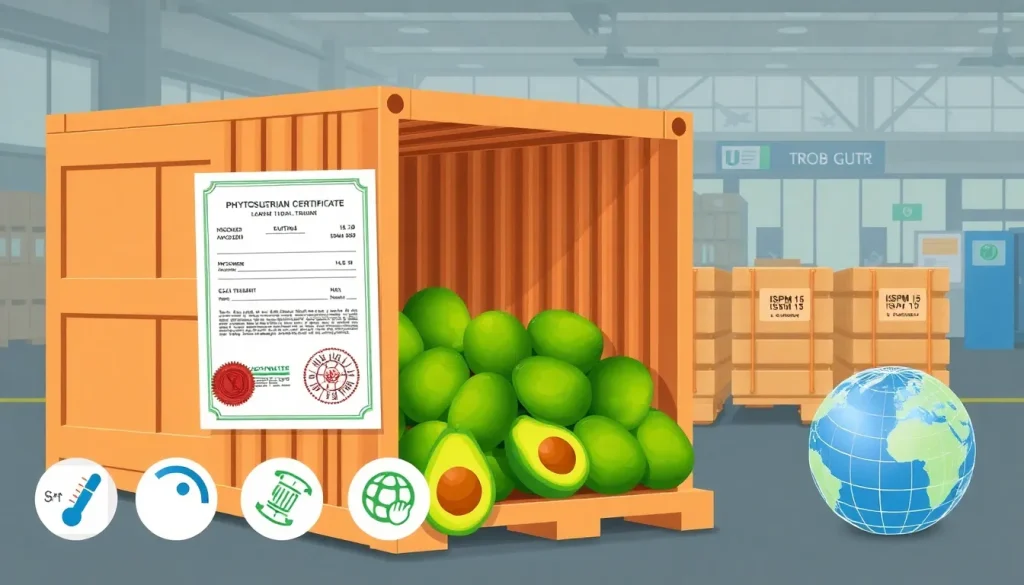
Phytosanitary requirements for avocado export are governed by the International Plant Protection Convention (IPPC) and implemented locally by each country’s National Plant Protection Organization (NPPO). The core document is the Phytosanitary Certificate (PC), which confirms that the consignment meets the importing country’s pest‑free standards. In addition to the PC, many jurisdictions demand specific treatments (e.g., cold treatment), pre‑export inspections, and compliance with ISPM standards such as ISPM 15 for wooden packaging.
Why It Matters (Real Stakes for Exporters/Importers)
Non‑compliance can trigger immediate rejection, re‑export, or destruction of the cargo, leading to:
- Loss of revenue – average avocado shipment value ranges from US$1,200‑2,500 per container.
- Reputational damage – repeat rejections affect future market access.
- Legal penalties – fines can exceed US$10,000 per violation in some jurisdictions.
- Supply‑chain disruption – downstream retailers may face stockouts.

Conversely, a well‑prepared phytosanitary package builds trust with import authorities and smooths customs clearance.
Regulatory Authority & Contact
Each importing country designates an NPPO that issues phytosanitary certificates and provides guidance. Below is a quick reference for the most common avocado‑importing markets:
| Country / Region | NPPO / Authority | Contact Email / Phone | Key Web Portal |
|---|---|---|---|
| European Union (EU) | European Commission – Plant Health Directorate | phytosanitary@ec.europa.eu | EU Plant Health Portal |
| United States (US) | U.S. Department of Agriculture – Animal & Plant Health Inspection Service (APHIS) | aphis.helpdesk@usda.gov | APHIS Plant Health |
| China | China Entry–Exit Inspection and Quarantine (CIQ) | ciq@ciq.gov.cn | CIQ Portal |
| Japan | Plant Protection Station, Ministry of Agriculture, Forestry and Fisheries (MAFF) | ppsjapan@maff.go.jp | MAFF Plant Health |
Import/Export Procedure
The typical flow for an avocado shipment is:
- Pre‑export preparation: Verify that the orchard is free of regulated pests, apply any mandatory treatments, and ensure packaging complies with ISPM 15.
- Official inspection: A qualified NPPO inspector visits the packing house, samples fruit, and checks for pests.
- Phytosanitary certificate issuance: The inspector signs the PC, which includes the commodity code, treatment details, and any conditional statements.
- Export declaration: The exporter files an electronic export declaration with the customs authority, attaching a scanned copy of the PC.
- Transport & border check: Upon arrival, the importing NPPO may request a physical inspection or request the original PC.
- Release: If the shipment meets all conditions, it is cleared for entry into the market.
Timing is critical – many NPPOs require the PC to be issued no more than 15 days before departure.
Required Documents
Besides the Phytosanitary Certificate, the following documents are commonly demanded:
- Commercial invoice – includes HS code 0804.50 (fresh avocados).
- Packing list – details of container numbers, weight, and fruit grade.
- Certificate of Origin – required for preferential tariff treatment.
- Treatment certificate – if cold treatment, fumigation, or other post‑harvest measures are applied.
- Import permit – some countries (e.g., EU) require a pre‑issued import permit for fresh produce.
All documents must be translated into the official language of the importing country unless a bilingual version is accepted.
Common Rejection Reasons at That Border
Historical data from the IPPC and national customs agencies show the following as the top reasons for avocado shipment rejection:
| Reason | Typical Finding | Remedial Action |
|---|---|---|
| Missing or expired Phytosanitary Certificate | Certificate dated >15 days before shipment or absent. | Obtain a new PC within the allowed window. |
| Pest presence | Detection of Fusarium oxysporum f.sp. peruviana or Thrips spp. in fruit samples. | Re‑treat orchard, conduct post‑harvest disinfestation, and resubmit. |
| Improper packaging | Wooden pallets not marked per ISPM 15. | Replace pallets with compliant heat‑treated or plastic alternatives. |
| Incorrect treatment declaration | Cold‑treatment temperature not recorded or below 2 °C for 14 days. | Provide documented temperature logs; repeat treatment if needed. |
| Documentation language mismatch | Certificates not translated into required language. | Submit certified translation before arrival. |
Requirements & Standards (Cite Primary Source)
The baseline standards are set out in the International Standards for Phytosanitary Measures (ISPM) series and the national regulations that adopt them. Key references include:
International Plant Protection Convention (IPPC). ISPM 15 – Regulated Wood Packaging Material. 2022. https://www.ippc.int/en/publications/standards/
European Commission. Regulation (EU) No 2019/2072 – Protective Measures against Pests of Plants. 2019. Official Journal of the European Union.
For avocados specifically, most importing NPPOs reference:
- IPPC Annex I – Persea americana (avocado) – listed as a host for Fusarium oxysporum f.sp. peruviana and Phytophthora palmivora.
- National pest‑free area (PFA) requirements – e.g., EU requires a cold treatment of 2 °C for 14 days or a certified post‑harvest disinfestation.
Step‑by‑Step Checklist (How‑to Trigger a Valid PC)
- Confirm the destination’s latest import requirements on the NPPO website.
- Schedule an official pre‑export inspection at least 10 days before loading.
- Apply any mandatory post‑harvest treatment (cold, fumigation) and retain temperature logs.
- Ensure all pallets, crates, and dunnage meet ISPM 15 markings (heat‑treated or methyl‑bromide).
- Prepare the following for the inspector:
- Batch records (harvest date, field location, cultivar).
- Treatment certificates and lab test results.
- Receive the Phytosanitary Certificate; verify that:
- All details (commodity, quantity, treatment) are correct.
- The issuance date is within the allowed window.
- Upload a scanned copy of the PC to the export declaration system.
- Attach original PC to the cargo and retain a duplicate for internal records.
- Notify the freight forwarder and customs broker of the PC reference number.
- Monitor arrival; be ready to provide the original PC to the importing NPPO on demand.
Common Mistakes & Rejection Reasons
Even experienced exporters slip up. The most frequent errors are:
- Late issuance: Certificate dated more than 15 days before departure.
- Incorrect HS code: Using 0804.51 (processed avocado) instead of 0804.50 (fresh).
- Unverified treatment: Forgetting to attach temperature log sheets.
- Packaging oversight: Mixing non‑ISPM‑15 pallets with compliant ones.
- Language gap: Supplying documents only in English for a French‑speaking market.
Mitigation strategy: create a pre‑shipment compliance checklist (see previous section) and conduct a mock audit 48 hours before loading.
Real‑World Example/Scenario
In 2023, a Peruvian exporter shipped a 20‑foot container of Hass avocados to the Netherlands. The shipment was held at Rotterdam because the PC listed a cold‑treatment temperature of 3 °C instead of the required 2 °C. The importing NPPO cited EU Regulation 2019/2072, which mandates 2 °C for a minimum of 14 days. The exporter had to repeat the cold‑treatment, re‑inspect the fruit, and obtain a new PC, incurring a delay of 7 days and an additional US$12,000 in handling costs. The lesson learned: always double‑check the exact numeric thresholds in the destination’s phytosanitary standard.
Conclusion
Phytosanitary compliance is not a peripheral paperwork exercise; it is the backbone of safe, reliable avocado trade. By mastering the core requirements—accurate certificates, proper treatments, compliant packaging, and timely documentation—exporters can avoid costly rejections and keep market doors open. Use the step‑by‑step checklist, stay current with NPPO updates, and treat the phytosanitary process with the same rigor you apply to the orchard itself.
| Quick Facts |
|---|
| Standard PC validity: ≤15 days before shipment. |
| EU cold‑treatment requirement: 2 °C for 14 days. |
| ISPM 15 wooden packaging must bear heat‑treatment stamp. |
| Common regulated pests: Fusarium oxysporum f.sp. peruviana, Phytophthora palmivora, Thrips spp. |
| Typical rejection rate for avocados (2022‑2023): 4 % across major markets. |
FAQ
How long before shipment can I request a phytosanitary certificate?
Most NPPOs require the PC to be issued no earlier than 15 days before the estimated time of departure. Issuing it earlier may invalidate the certificate.
Do I need a separate certificate for each container?
Yes. Each container or shipment batch must have its own PC that lists the exact quantity, cultivar, and treatment details for that specific lot.
What if my wooden pallets lack the ISPM 15 heat‑treatment mark?
The shipment will be detained and may be re‑exported or destroyed. Replace non‑compliant pallets with properly marked ones or use alternative packaging such as plastic or metal pallets.





Leave a Reply