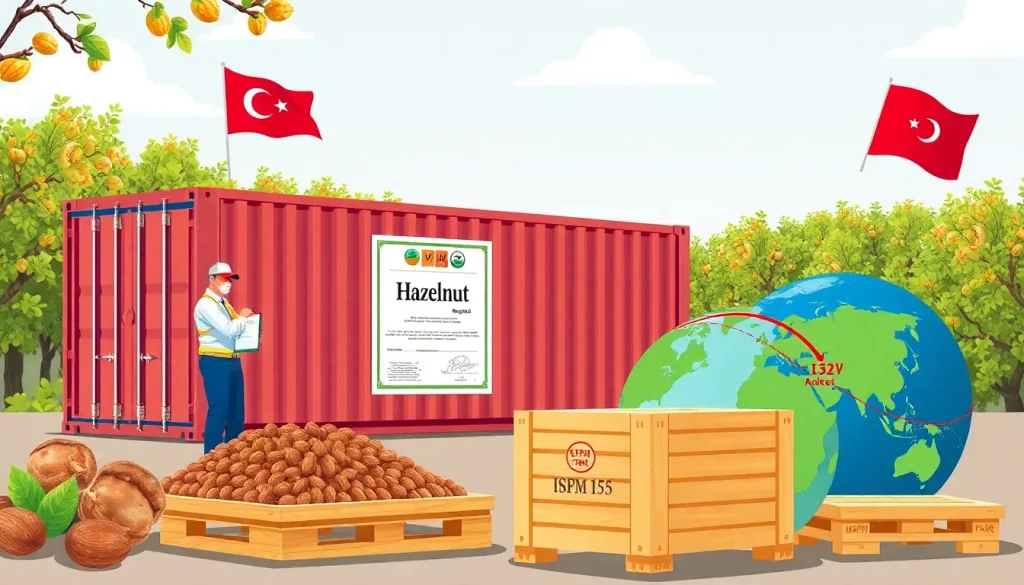
Short Answer
Turkey is the world’s leading producer of hazelnuts, accounting for more than 70% of global supply. Because hazelnuts are a high‑value commodity, many importing countries impose strict plant‑health controls to prevent the entry of pests and diseases. This article consolidates the current Turkish export framework, the role of the National Plant Protection Organization (NPPO), and the practical steps exporters, importers, customs brokers, and freight forwarders must follow to obtain a valid phytosanitary certificate and clear customs without delay.
Overview
Hazelnut (Corylus avellana L.) exports from Turkey are governed by the Turkish Plant Protection Law No. 2935, its implementing regulations, and the International Plant Protection Convention (IPPC) standards. The Ministry of Agriculture and Forestry’s Directorate General of Plant Protection and Quarantine (DGPPQ) issues the phytosanitary certificate (PC) that certifies the consignment is free from regulated pests. Export requirements vary by destination, but the baseline Turkish standards are uniform across all markets.
Why it matters (real stakes for exporters/importers)
Non‑compliance can lead to:
- Shipment rejection or delayed release at the port of entry, incurring demurrage charges.
- Financial penalties imposed by Turkish customs under Article 45 of the Plant Protection Law.
- Loss of market access if a importing country records a phytosanitary breach, potentially triggering trade bans.
- Reputational damage for exporters and importers, affecting future contracts.
Given that hazelnut contracts often involve multi‑million‑dollar values, a single rejected consignment can erode profit margins and strain business relationships.
How it works
The export flow follows a four‑step cycle:
- Pre‑export inspection: The exporter notifies the DGPPQ of the intended shipment and provides a sampling plan.
- Field & laboratory testing: Samples are examined for regulated pests such as Cryptorhynchus lapathi (hazelnut weevil) and fungal pathogens like Hymenoscyphus fraxineus.
- Issuance of Phytosanitary Certificate: Upon satisfactory results, the DGPPQ signs the PC, which must accompany the cargo.
- Customs clearance: Turkish customs releases the shipment; the importing country’s NPPO may request a copy of the PC for verification.
The process must be completed within 10 working days of the exporter’s request, unless a special inspection is required.
Regulatory authority & contact
The competent NPPO for hazelnut export is:
| Agency | Address | Phone | |
|---|---|---|---|
| Directorate General of Plant Protection and Quarantine (DGPPQ) | Ministry of Agriculture and Forestry, Ankara, Turkey | +90 312 444 0 123 | phytosanitary@tarim.gov.tr |
For urgent inquiries, the DGPPQ operates a 24‑hour hotline ( +90 312 444 0 124 ) and an online portal https://www.tarim.gov.tr/phytosanitary where exporters can upload documents and track certificate status.
Import/export procedure
Exporters must follow the standardized procedure below:
- Register the shipment in the Turkish Export Licensing System (TEM).
- Submit a Phytosanitary Inspection Request Form (PDF‑001) together with the commercial invoice, packing list, and origin certificate.
- Schedule an on‑site inspection; the DGPPQ inspector verifies field conditions, storage hygiene, and sampling compliance.
- Laboratory analysis is performed at the National Plant Protection Laboratory (NPPL). Results must be negative for all pests listed in Annex II of the IPPC.
- If a regulated pest is detected, the consignment must undergo treatment (e.g., cold treatment at –5 °C for 14 days) before re‑inspection.
- Upon clearance, the inspector issues a draft PC; the exporter signs and returns it to the DGPPQ.
- The DGPPQ signs the final PC, affixes the official seal, and uploads a digital copy to the TEM portal.
“The phytosanitary certificate shall be issued only after the consignment has been inspected and found free from quarantine pests as defined in the IPPC Annex II. (Turkish Plant Protection Regulation, Art. 12)”
- Attach the original PC to the bill of lading; retain a copy for customs filing.
Required documents
Export documentation package includes:
- Commercial invoice (in English and Turkish).
- Packing list detailing lot numbers, net weight, and container seals.
- Certificate of Origin (issued by the Turkish Chamber of Commerce).
- Phytosanitary Inspection Request Form (PDF‑001).
- Laboratory test report (if applicable).
- Phytosanitary Certificate (original, signed by DGPPQ).
- Import permit or pre‑clearance letter from the destination NPPO (when required).
All documents must be presented in both Turkish and English unless the importing country specifies otherwise.
Requirements & standards (cite primary source: IPPC/NPPO)
The baseline standards are derived from:
- IPPC International Standards for Phytosanitary Measures (ISPM) 15 – specifying treatment of regulated articles.
- Turkish Plant Protection Law No. 2935 and its implementing regulation (2023 amendment).
- EU Regulation (EU) 2019/2072 – for exports destined to the European Union, which adopts the same pest list as Annex II of the IPPC.
Key compliance points:
- Hazelnuts must be dry‑cured to a moisture content ≤ 6% before inspection.
- No visible signs of insect damage, fungal infection, or weed seed contamination.
- All packaging (wooden crates, pallets) must comply with ISPM 15 (heat‑treated or fumigated).
- Certificates must be issued within 30 days prior to shipment; otherwise, a re‑inspection is mandatory.
Common rejection reasons at that border
Importing authorities frequently reject Turkish hazelnut shipments for the following:
- Missing or illegible phytosanitary certificate.
- Detection of Cryptorhynchus lapathi larvae in cracked kernels.
- Moisture content exceeding the 6% limit, indicating risk of mold.
- Use of untreated wooden pallets violating ISPM 15.
- Incorrect commodity description (e.g., listed as “raw nuts” instead of “shell‑removed, roasted”).
In most cases, the shipment is held for secondary inspection and may be returned to Turkey for treatment, incurring additional costs.
Step‑by‑step checklist (How‑to trigger)
Exporters can use the following checklist to ensure a smooth certification process:
- Verify that the destination country’s import requirements are up‑to‑date (consult the NPPO website).
- Confirm that the hazelnut lot meets the moisture (<6%) and visual quality standards.
- Prepare all required documents (invoice, packing list, origin certificate, inspection request).
- Log into the TEM portal and submit the inspection request at least 12 days before the intended shipment date.
- Schedule the on‑site inspection and ensure that pallets are ISPM 15 compliant.
- Await laboratory test results; if a pest is found, arrange the prescribed treatment and request a re‑inspection.
- Receive the draft PC, review for accuracy, and sign.
- Obtain the final PC from the DGPPQ, attach it to the bill of lading, and upload a digital copy to TEM.
- Inform the freight forwarder and the importing agent of the PC number and issuance date.
- Retain all records for a minimum of five years for audit purposes.
Common mistakes & rejection reasons
Even experienced exporters slip into avoidable errors. The most frequent mistakes are:
- Late application – submitting the inspection request less than 5 days before departure, which prevents timely laboratory analysis.
- Inadequate sample size – providing fewer than 5 kg of nuts for laboratory testing, leading to non‑representative results.
- Improper pallet marking – omitting the ISPM 15 heat‑treatment symbol, causing immediate border detention.
- Translation errors – mismatched commodity codes (HS 0801 vs 0802) that trigger additional customs checks.
- Failure to update pest list – ignoring newly regulated pests such as Anisogramma anomala (hazelnut anthracnose) added to Annex II in 2022.
Addressing these pitfalls early saves time and money.
Real‑world example/scenario
In March 2024, a Turkish exporter shipped 12 metric tonnes of roasted hazelnuts to the United Kingdom. The consignment was held at Dover because the wooden pallets lacked the ISPM 15 heat‑treatment mark. The importer requested an urgent re‑inspection; the exporter had to replace the pallets, incur a €2,500 freight surcharge, and delay delivery by 7 days. The incident was resolved after the DGPPQ re‑issued the PC with a supplemental pallet certification. This case underscores the importance of verifying packaging compliance before loading.
Conclusion
Turkey’s hazelnut export chain is tightly regulated to protect both domestic agriculture and the plant‑health status of trading partners. By understanding the role of the DGPPQ, adhering to moisture and pest‑free standards, and preparing a complete documentation package, exporters can secure a valid phytosanitary certificate and avoid costly rejections. The step‑by‑step checklist and common‑mistake guide provide a practical roadmap for seamless international trade.
| Quick Fact | Detail |
|---|---|
| Top exporter | Turkey supplies ~70 % of global hazelnuts. |
| Moisture limit | ≤ 6 % (dry‑cured) for certification. |
| Key pest list | Cryptorhynchus lapathi, Hymenoscyphus fraxineus, Anisogramma anomala. |
| Certificate validity | 30 days from issuance. |
| ISPM 15 requirement | All wooden packaging must be heat‑treated or fumigated. |
FAQ
How long does it take to obtain a phytosanitary certificate for hazelnuts?
The DGPPQ normally issues the certificate within 10 working days after the inspection request, provided all samples test negative and documentation is complete.
Do I need a separate certificate for each destination country?
A single Turkish PC is valid for any importing country that accepts Turkish certification, but some destinations (e.g., the EU) may require an additional import permit or pre‑clearance letter.
What treatment is required if the hazelnut weevil is detected?
The consignment must undergo a cold treatment at –5 °C for a minimum of 14 days, followed by a re‑inspection and issuance of a new PC.





Leave a Reply