Short Answer
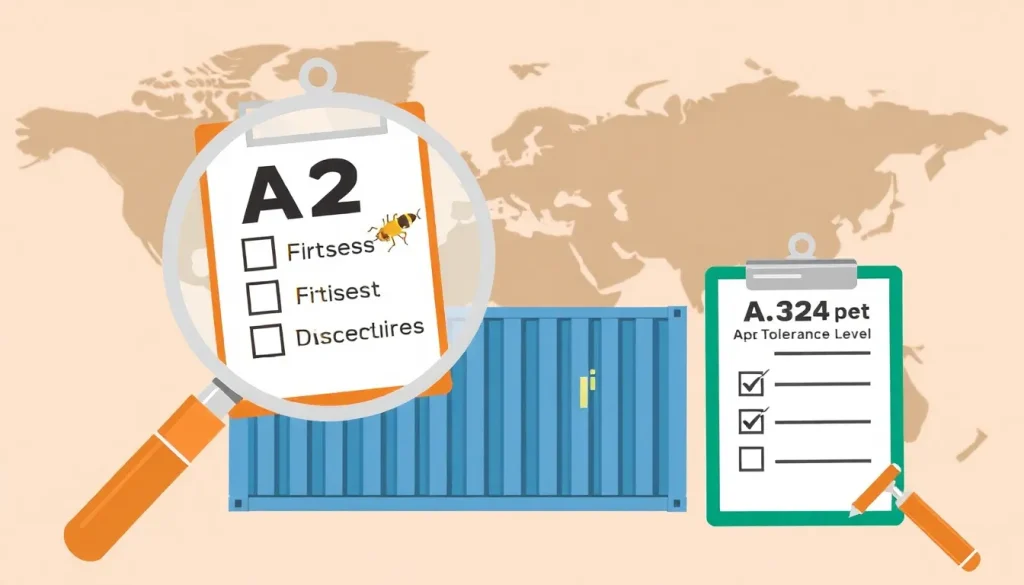
In the global plant‑health system, pests are grouped into categories that dictate how strictly they are controlled at borders. An A2 pest is a regulated organism that may be present in a trading partner’s territory but is not established in the importing country. Unlike A1 pests, which demand a zero‑tolerance, A2 pests are often allowed a limited, scientifically‑derived tolerance level. Understanding how those tolerance levels are set—and how to prove compliance—is essential for anyone moving plant material across international borders.
Overview
The International Plant Protection Convention (IPPC) classifies pests as A1 (absent or eradicated) or A2 (present but not widely established). A2 pests are listed in the IPPC’s International Standards for Phytosanitary Measures (ISPM) and each National Plant Protection Organization (NPPO) may adopt additional tolerances based on local risk assessments.
Tolerance level refers to the maximum number of live or dead pest individuals, life stages, or infested units that a shipment may contain without being rejected. Tolerances can be expressed as:
- Maximum number per consignment (e.g., ≤5 live insects per 1,000 kg).
- Maximum percentage of infested items (e.g., ≤0.1% of fruit units).
- Detection threshold in inspections (e.g., no more than one larva per 10 kg of seed lot).
These limits are derived from scientific risk analysis, trade impact studies, and the feasibility of inspection or treatment methods.
Why It Matters (Real Stakes for Exporters/Importers)
Failure to meet A2 tolerance levels can trigger immediate shipment rejection, costly re‑inspection, or mandatory treatment at the border. The financial impact includes:
- Loss of market access for the affected consignment.
- Additional phytosanitary treatment fees (e.g., cold treatment, fumigation).
- Potential loss of future export privileges if a pattern of non‑compliance emerges.
- Reputational damage for producers and freight forwarders.
Conversely, accurate knowledge of tolerance thresholds enables exporters to design pre‑shipment inspections, choose appropriate treatments, and provide the documentation customs officials demand, thereby smoothing the clearance process.
How It Works (Determination Process)
The determination of an A2 pest’s tolerance level follows a structured pathway:
- Risk Assessment: The NPPO conducts a pest risk analysis (PRA) per ISPM 5, evaluating likelihood of entry, establishment, and economic impact.
- Scientific Evidence: Data on pest biology, host range, climatic suitability, and detection limits are compiled from peer‑reviewed literature and surveillance reports.
- Trade Impact Review: The NPPO weighs the cost of stricter measures against the potential damage from an incursion.
- Stakeholder Consultation: Exporters, importers, and industry groups provide feedback on feasibility of proposed tolerances.
- Regulatory Adoption: The final tolerance is codified in the importing country’s phytosanitary regulations (often published in an official Gazette or on the NPPO website).
- Verification: Ongoing monitoring ensures the tolerance remains appropriate; adjustments are made when new scientific data emerge.
Because each NPPO may interpret the same IPPC standards differently, exporters must verify the specific tolerance listed for the destination country.
Regulatory Authority & Contact
The primary bodies responsible for setting and enforcing A2 pest tolerances are:
- International Plant Protection Convention (IPPC) – establishes the global framework (ISPM 5, ISPM 21, ISPM 31).
- National Plant Protection Organization (NPPO) – the official agency in each country (e.g., USDA‑APHIS in the United States, DG SANTÉ in France).
- Regional Plant Protection Organizations (RPPOs) – may issue harmonized tolerances for member states (e.g., EPPO).
Exporters should keep a contact list for the NPPO’s phytosanitary division. Sample contact format:
USDA‑APHIS Plant Protection and Quarantine
Phone: +1‑202‑720‑2791
Email: phytosanitary@aphis.usda.gov
Website: https://www.aphis.usda.gov/aphis/ourfocus/planthealth
Requirements & Standards (Citing Primary Sources)
The core standards governing A2 pest tolerances are:
| Standard | Key Provision | Reference |
|---|---|---|
| ISPM 5 – Pest Risk Analysis | Mandates scientific risk assessment before setting tolerances. | IPPC, 2022 |
| ISPM 21 – Pest Surveillance | Specifies inspection intensity and sampling plans for A2 pests. | IPPC, 2023 |
| ISPM 31 – Standard for Phytosanitary Certificates | Requires declaration of compliance with A2 tolerance levels on the certificate. | IPPC, 2021 |
| WTO SPS Agreement | Allows members to set non‑discriminatory tolerances based on scientific risk. | WTO, 1995 |
When an A2 pest is listed, the NPPO will publish a specific tolerance in its national plant‑health regulations. For example, the United States cites 7 CFR 319.56‑1, which permits no more than one live larva per 10 kg of seed lot for the soybean cyst nematode (Heterodera glycines) when imported from certain regions.
Step‑by‑Step Checklist (How to Meet Tolerance Levels)
- Identify the Destination’s A2 Pest List – consult the NPPO website or the IPPC’s online pest database.
- Confirm the Exact Tolerance Value – note the unit (e.g., per kg, per 1,000 items) and any special conditions (e.g., post‑treatment).
- Arrange Pre‑Export Inspection – use an accredited phytosanitary inspector to sample the consignment according to the sampling plan in ISPM 21.
- Document Findings – fill out the inspection report, noting the number of pests detected versus the allowed limit.
- Apply Required Treatment (if any) – e.g., cold treatment, methyl bromide, or heat treatment, and obtain a treatment certificate.
- Prepare the Phytosanitary Certificate – reference the specific A2 pest tolerance clause (e.g., “Meets tolerance of ≤5 live insects per 1,000 kg”).
- Submit Documentation to the Importer – include inspection report, treatment certificate, and the original phytosanitary certificate.
- Retain Records for 2 Years – customs may request audit copies during post‑clearance verification.
Common Mistakes & Rejection Reasons
Even experienced exporters stumble over a few recurring pitfalls:
- Using the Wrong Tolerance Figure – mixing up A1 zero‑tolerance with A2 limited tolerance.
- Insufficient Sample Size – failing to meet the ISPM 21 sampling intensity leads to “insufficient evidence” rejections.
- Missing Treatment Certification – when a post‑harvest treatment is mandatory, the absence of a valid certificate triggers denial.
- Incorrect Unit Reporting – reporting pests per pallet instead of per kilogram.
- Out‑of‑Date NPPO Guidance – regulations are updated regularly; using outdated PDFs is a common error.
Customs officers typically cite the exact regulation in the rejection notice, e.g., “Violation of 7 CFR 319.56‑1: tolerance of one live larva per 10 kg exceeded.”
Real‑World Example/Scenario
Scenario: A Spanish citrus exporter ships 12 tons of Valencia oranges to the United States. The Mediterranean fruit fly (Ceratitis capitata) is listed as an A2 pest for the U.S. with a tolerance of no more than 1 adult fly per 5,000 kg.
Steps taken:
- The exporter consulted the USDA‑APHIS A2 pest list and confirmed the C. capitata tolerance.
- A USDA‑approved inspector performed a stratified random sample of 200 oranges, finding 0 adult flies.
- Because the tolerance allowed 2 flies (12 000 kg ÷ 5,000 kg = 2.4 → round down to 2), the shipment was within limits.
- The inspector issued a phytosanitary certificate stating, “Meets tolerance for Ceratitis capitata – ≤1 adult per 5,000 kg.”
- The consignment cleared U.S. customs without delay.
If the inspection had uncovered 3 flies, the shipment would have been rejected, and the exporter would have needed to either treat the lot (cold treatment) or re‑ship a new, pest‑free consignment.
Conclusion
Tolerance levels for A2 pests are a critical bridge between strict biosecurity and realistic trade. They are set through a transparent scientific process, codified in IPPC standards and national regulations, and enforced by customs officials who rely on precise documentation. By understanding the underlying risk analysis, staying current with NPPO guidance, and following a disciplined pre‑export checklist, exporters can avoid costly rejections and maintain reliable market access.
FAQ
Can an A2 pest ever be allowed with zero tolerance?
Yes. If the importing NPPO determines that the pest poses an extremely high risk, it may impose a zero‑tolerance even though the pest is listed as A2.
How often do tolerance levels change?
Tolerance levels are reviewed whenever new scientific data become available, typically every 3–5 years, but urgent changes can occur after an outbreak.
Do tolerances apply to dead insects as well as live ones?
Most NPPOs differentiate; some tolerances are expressed for live stages only, while others include dead or damaged insects. Always check the specific regulation.





Leave a Reply