Short Answer
Every year, billions of dollars of fresh produce, seeds, and ornamental plants cross international borders. Behind each shipment lies a network of rules designed to keep harmful organisms out of new territories. At the heart of those rules is the concept of a quarantine pest—an organism that, if introduced, could devastate agriculture, forestry, or natural ecosystems. This article breaks down the definition, the stakes for trade, and the exact steps you need to follow to avoid costly delays.
Overview
A quarantine pest is defined by the International Plant Protection Convention (IPPC) as an organism that is either absent from a country or present only under official control, and whose introduction or spread would cause significant economic loss, environmental harm, or affect human health. The term is synonymous with “regulated pest” in many national phytosanitary regulations.
Key attributes of a quarantine pest include:
- Regulatory status: Listed in the importing country’s official pest list or in the IPPC’s International Standards for Phytosanitary Measures (ISPM) 5.
- Potential impact: High likelihood of causing yield loss, trade disruption, or biodiversity damage.
- Control requirement: Requires official inspection, treatment, or eradication before a phytosanitary certificate can be issued.
Why It Matters (Real Stakes for Exporters/Importers)
For businesses that move plant material across borders, a quarantine pest can be the difference between a smooth delivery and a shipment held at the border for weeks or even destroyed.
- Financial loss: Rejection can mean lost sales, re‑packaging costs, and possible fines.
- Reputational risk: Repeated non‑compliance may lead to stricter inspections or loss of market access.
- Legal consequences: Many countries impose penalties under their Plant Protection Acts for non‑compliance.
- Supply‑chain disruption: Delays ripple through distributors, retailers, and end‑consumers.
Understanding quarantine pest requirements therefore protects profit margins and preserves long‑term market relationships.
Host Range
Quarantine pests are identified by the breadth of plant species they can attack. A wide host range increases the risk of inadvertent spread.
| Category | Typical Hosts | Example Pest |
|---|---|---|
| Broad‑leaf crops | Wheat, barley, maize, rice, sorghum | Spodoptera frugiperda (Fall armyworm) |
| Fruit & nut trees | Apple, peach, almond, walnut | Bactrocera dorsalis (Oriental fruit fly) |
| Ornamentals | Roses, chrysanthemums, poinsettia | Phytophthora ramorum (Sudden oak death pathogen) |
When preparing a shipment, verify that none of the listed hosts are present unless the pest is specifically exempted.
Symptoms / Identification (ID)
Early detection hinges on recognizing visual signs and laboratory diagnostics. Common symptom categories include:
- Foliar damage: Chewed leaves, stippling, or chlorosis.
- Fruit blemishes: Sunken lesions, rotting spots, or abnormal ripening.
- Root or stem decay: Softening, discoloration, or fungal mycelium.
- Insect life stages: Eggs, larvae, pupae, or adult traps.
Confirmatory testing may involve:
- Morphological keys (e.g., USDA APHIS Insect Identification Manual).
- Polymerase Chain Reaction (PCR) for pathogen DNA.
- Serological assays such as ELISA for viruses.
Accurate identification is a prerequisite for any phytosanitary certification.
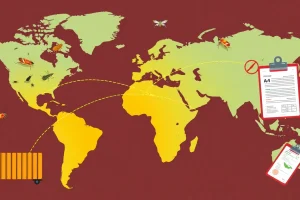
Distribution & Regulatory Status (A1/A2 by Region)
Quarantine pests are tracked in three main categories:
- A1 – Not present, no known occurrence: Fully regulated; entry is prohibited unless a specific treatment is applied.
- A2 – Present but under official control: Movement may be allowed after stringent measures.
- B – Not regulated (non‑quarantine): May be present without special restrictions.
For example, the Asian citrus psyllid (Diaphorina citri) is listed as A1 in most EU member states, while the Mediterranean fruit fly (Ceratitis capitata) is A2 in the United States, meaning it can be moved under approved treatment protocols.
“Member countries shall adopt measures to prevent the introduction of quarantine pests as defined in Annex I of the IPPC.” – IPPC, ISPM 5 (2021)
Control / Treatment
Effective control strategies are mandated before a phytosanitary certificate can be issued. Options include:
- Cold treatment: Exposure to 0 °C for a defined period (e.g., 14 days for certain fruit flies).
- Heat treatment: Heating to 55 °C for 30 minutes for many nematodes.
- Fumigation: Methyl bromide or phosphine, applied according to the USDA-APHIS or EU guidelines.
- Biological control: Release of natural enemies (rarely accepted for export certification).
- Phytosanitary inspection & removal: Manual removal of infested material.
All treatments must be documented on a Phytosanitary Certificate of Treatment (PCT) or similar official form.
Requirements & Standards
The primary sources governing quarantine pest compliance are:
- IPPC – International Standards for Phytosanitary Measures (ISPM): ISPM 5 (Pest Risk Analysis) and ISPM 15 (Wood Packaging) provide the global baseline.
- National Plant Protection Organization (NPPO): Each country publishes its own pest list and treatment standards. For example, the United States Department of Agriculture (USDA) APHIS releases the Import Requirements for Plants database.
- World Trade Organization (WTO) – SPS Agreement: Requires that measures be based on scientific risk assessment and not be more trade‑restrictive than necessary.
Key compliance points:
- Obtain an up‑to‑date pest list from the importing NPPO.
- Ensure that any required treatment is performed by an authorized facility.
- Provide a phytosanitary certificate signed by the NPPO that references the specific ISPM code(s) satisfied.
Step‑by‑Step Checklist (How‑to Trigger Compliance)
- Identify the commodity and its origin. Verify the scientific name and HS code.
- Consult the importing country’s NPPO pest list. Look for A1/A2 status of relevant pests.
- Determine required treatment. Follow the exact temperature, duration, or fumigant concentration stipulated.
- Engage a certified treatment provider. Retain the treatment record (e.g., temperature logs, gas concentration charts).
- Arrange pre‑export inspection. An authorized inspector must confirm that the commodity is pest‑free.
- Inspect for visual symptoms.
- Submit samples for laboratory confirmation if required.
- Request a phytosanitary certificate. Include:
- Commodity description
- Origin and destination
- Reference to the specific ISPM(s) satisfied
- Treatment details (method, date, provider)
- Attach the certificate to the shipment. Ensure the document is legible and matches the bill of lading.
- Prepare for possible border inspection. Keep treatment records and any laboratory reports on hand.
Following this checklist reduces the chance of a quarantine pest‑related hold at the border.
Common Mistakes & Rejection Reasons
Even experienced exporters stumble over a few recurring pitfalls:
- Out‑of‑date pest list: Using an older NPPO list can miss newly added quarantine pests.
- Incomplete treatment documentation: Missing temperature logs or fumigant concentration sheets leads to certificate denial.
- Incorrect commodity description: Vague or misspelled scientific names trigger additional scrutiny.
- Failure to declare host plants: Not listing all host species in the shipment can be seen as non‑disclosure.
- Improper packaging: Using untreated wood pallets when ISPM 15 requires heat‑treated or fumigated wood.
Typical border rejection notices cite “Non‑conformity with ISPM 15” or “Presence of quarantine pest X not declared.”
Real‑World Example / Scenario
Scenario: A U.S. exporter ships fresh mangoes from Florida to the European Union (EU). The EU lists the mango fruit fly (Bactrocera dorsalis) as an A1 quarantine pest.
- The exporter checks the EU’s NPPO portal and confirms A1 status.
- EU regulations require a cold treatment of 2 °C for at least 14 days.
- The mangoes are placed in an EU‑approved cold‑store facility; temperature logs are recorded.
- After the treatment, an authorized EU phytosanitary inspector conducts a visual examination and finds no fruit‑fly larvae.
- A phytosanitary certificate is issued, citing ISPM 15 compliance for the wooden pallets and ISPM 5 for the pest risk analysis.
“The certificate confirms that the consignment complies with EU Regulation (EU) 2019/2072 concerning fruit‑fly free status.” – EU Commission, 2023
- The shipment clears EU customs without delay, and the mangoes reach retail shelves within 48 hours.
This example illustrates how adherence to quarantine pest protocols turns a potential barrier into a smooth trade transaction.
Conclusion
Quarantine pests are the gatekeepers of global plant health. Understanding their definition, the regulatory framework, and the practical steps required for compliance protects both the agricultural economy and the environment. By consulting up‑to‑date NPPO lists, applying the correct treatment, and maintaining flawless documentation, exporters and importers can keep their supply chains moving and avoid costly rejections.
FAQ
How can I find out if a pest is considered a quarantine pest in a specific country?
Visit the importing country’s NPPO website or use the IPPC’s online pest list. Look for the pest’s status (A1, A2, or B) and note any required treatments.
Do all plant commodities need a phytosanitary certificate?
Only commodities that are regulated by the importing country’s plant‑health rules require a certificate. Non‑regulated items (status B) may be shipped without one, but it is good practice to verify.
Can a quarantine pest be treated after the shipment has left the exporting country?
Generally no. The required treatment must be completed and documented before the phytosanitary certificate is issued. Post‑shipment treatment does not satisfy most import requirements.





Leave a Reply