Short Answer
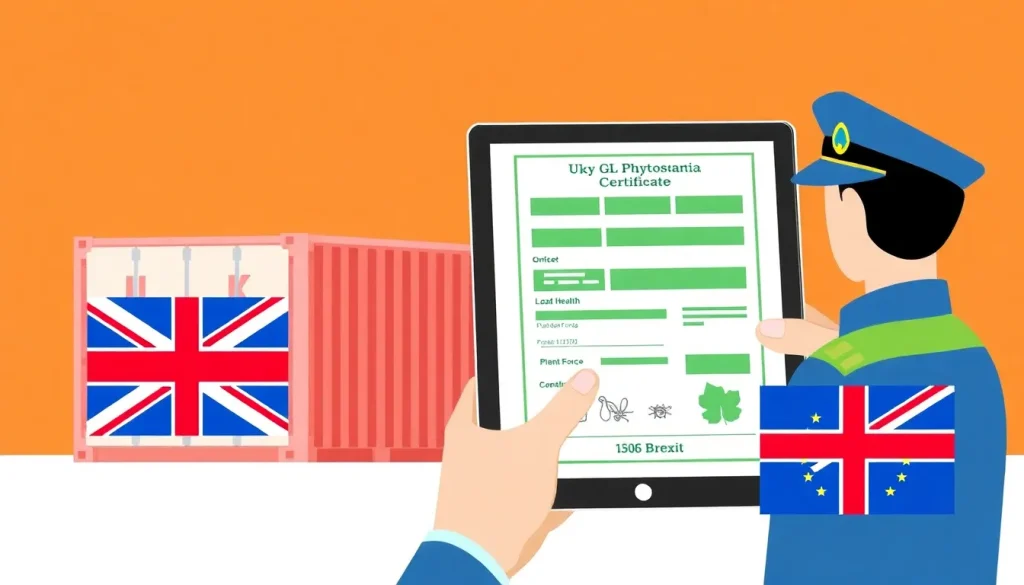
Since the United Kingdom left the European Union on 31 January 2020, its plant‑health import regime has diverged from the EU’s. Exporters, importers, customs brokers and freight forwarders must now obtain a separate UK Phytosanitary Certificate (UK‑PC) that meets the standards set by the UK’s National Plant Protection Organisation (NPPO) and the International Plant Protection Convention (IPPC). This article breaks down every element you need to know to ship plant commodities safely and compliantly to Great Britain and Northern Ireland.
Overview
The UK Phytosanitary Certificate is an official document issued by the exporting country’s NPPO (or an authorized body) confirming that the consignment complies with the United Kingdom’s plant‑health import requirements. After Brexit, the UK no longer recognises the EU’s phytosanitary certificate for most regulated commodities, and a distinct UK‑PC must be presented at the border.
Key points of the overview:
- Applicable to all plant products, seeds, cut‑flowers, fruit, timber, and soil‑bearing items destined for Great Britain (England, Scotland, Wales) and Northern Ireland under the Windsor Framework.
- Certificates are issued electronically via the UK’s Department for Environment, Food & Rural Affairs (Defra) portal.
- Failure to present a valid UK‑PC results in detention, treatment, or rejection at the border.
Why it Matters (Real Stakes for Exporters/Importers)
Non‑compliance can have costly consequences:
- Financial loss: Detention fees, re‑inspection charges, and possible destruction of the consignment can quickly exceed the value of the goods.
- Supply‑chain disruption: Delays affect downstream retailers and can breach contract delivery windows.
- Reputational damage: Repeated rejections may lead to loss of market access or a downgrade in the exporter’s risk rating.
- Regulatory penalties: The UK can impose fines up to £5,000 per non‑conforming consignment under the Plant Health (England) Regulations 2015.
Understanding the UK‑PC requirement is therefore a risk‑mitigation priority for any business moving plant material into the United Kingdom.
Regulatory Authority & Contact
The UK’s plant‑health regime is administered by the following bodies:
| Authority | Role | Contact |
|---|---|---|
| Department for Environment, Food & Rural Affairs (Defra) | Overall policy, import controls, and issuance of the UK‑PC. | phytosanitary@defra.gov.uk | +44 300 123 4567 |
| Animal and Plant Health Agency (APHA) | Operational inspections at the border and technical advice. | aphael@apha.gov.uk | +44 1242 xxxxxx |
| UK National Plant Protection Organisation (UK‑NPPO) | Maintains the pest‑free list, publishes the Plant Health Risk Register. | nppo@defra.gov.uk |
Exporters should keep these contacts handy for clarification on pest‑specific requirements or to arrange urgent inspections.
Import/Export Procedure
The end‑to‑end flow for a UK‑PC is as follows:
- Pre‑export verification: Confirm that the commodity is allowed, check the UK’s pest‑free list, and determine any required treatments.
- Apply for the certificate: Submit an electronic request through the exporting country’s NPPO portal (e.g., USDA Phytosanitary Certificate System for the United States, or the Australian Department of Agriculture’s e‑PC).
- Inspection & sampling: An authorized NPPO inspector examines the consignment, takes samples if required, and records findings.
- Certificate issuance: The NPPO issues the UK‑PC, which includes a unique serial number, commodity description, origin, and any phytosanitary measures taken.
- Transport & presentation: The exporter forwards the electronic certificate (or printed copy where required) to the freight forwarder. The document is presented to UK Border Force (UKBF) on arrival.
- Border clearance: UKBF checks the certificate against the Import Control System (ICS). If all data match, the consignment is released.
Any deviation at step 4 (e.g., missing treatment evidence) triggers a rejection or secondary inspection.
Required Documents
In addition to the UK‑PC, the following paperwork is commonly required:
- Commercial invoice – shows commodity value and HS code.
- Bill of lading or airway bill – details the carrier and route.
- Import licence (if applicable) – certain high‑risk pests require a pre‑grant of entry.
- Laboratory test report – for seeds, tubers, or other propagative material that must meet germination or pathogen‑free standards.
- Fumigation or treatment certificate – where a specific phytosanitary treatment (e.g., heat, methyl bromide) is mandated.
All documents must be in English or accompanied by a certified translation.
Requirements & Standards
“The United Kingdom adopts the International Standards for Phytosanitary Measures (ISPM) as published by the IPPC, with national amendments where required (Defra 2023).” – Defra Plant Health Regulations
Key standards that underpin the UK‑PC:
- ISPM 15 – Regulates wood packaging material; must be heat‑treated (HT) or fumigated (MHP).
- ISPM 36 – Governs the certification of seeds and other propagative material.
- UK Plant Health (England) Regulations 2015 – Implements IPPC provisions and defines the legal basis for the UK‑PC.
- Windsor Framework (2020) – Sets out the separate regime for Northern Ireland, allowing EU certificates for certain categories but still requiring UK‑PC for many goods.
Exporters must ensure that any treatment, inspection or sampling meets the exact parameters described in these ISPMs; otherwise the certificate will be deemed invalid.
Step‑by‑Step Checklist (How‑to Trigger a UK‑PC)
- Identify the HS code of the commodity and verify it is permitted for entry into the UK via the Defra Import Controls list.
- Check the UK’s Pest‑Free List (PFL) for the origin country; ensure the commodity’s origin is listed as pest‑free for the relevant pests.
- Arrange any mandatory pre‑export treatment (e.g., heat‑treatment for wood, cold‑treatment for fruit).
- Gather supporting documents: commercial invoice, bill of lading, treatment certificate, laboratory test report.
- Log into the exporting country’s NPPO electronic portal and submit a “UK Phytosanitary Certificate” request, attaching all supporting files.
- Schedule an on‑site inspection; provide the inspector with access to the consignment and any required sampling tools.
- Receive the electronic UK‑PC with its unique serial number; download and save a PDF copy.
- Transmit the certificate to the freight forwarder and confirm that the carrier’s documentation system (e.g., CHIEF, CDS) includes the certificate reference.
- On arrival, present the UK‑PC to UK Border Force; retain a copy of the border clearance receipt.
- Maintain records for at least five years, as required by Defra for audit purposes.
Following this checklist reduces the likelihood of a last‑minute rejection.
Common Mistakes & Rejection Reasons
Even experienced exporters slip up. The most frequent causes of UK‑PC rejection are:
- Incorrect commodity description – mismatched HS code or vague wording.
- Missing or outdated treatment evidence – e.g., using an expired heat‑treatment certificate.
- Failure to list the correct origin – the UK PFL is country‑specific; a generic “Europe” entry is insufficient.
- Non‑English documentation without certified translation.
- Using an EU Phytosanitary Certificate instead of a UK‑PC.
- Late submission – certificates must be issued no more than 30 days before export (or 14 days for highly perishable goods).
n
When a rejection occurs, UKBF issues a “Notice of Refusal” that details the exact deficiency. Promptly addressing the issue and resubmitting a corrected certificate is essential to avoid further delays.
Real‑World Example/Scenario
Scenario: A Dutch grower exports 20 tons of fresh apples to a retailer in Manchester. The apples are harvested in the Netherlands, a country listed as pest‑free for Cydia pomonella (codling moth) on the UK PFL.
Steps taken:
- The grower confirms that ISPM 15‑compliant pallets are used.
- A pre‑export cold treatment (−2 °C for 14 days) is performed to meet the UK requirement for Brevicoryne brassicae.
- All supporting documents (treatment certificate, lab test for pesticide residues, commercial invoice) are uploaded to the Netherlands NPPO portal.
- The NPPO issues a UK‑PC (serial UK‑PC‑2024‑00123) 10 days before shipment.
- The freight forwarder includes the certificate reference in the airway bill.
- Upon arrival at Southampton, UKBF scans the certificate, finds it valid, and releases the consignment within 2 hours.
Had the grower submitted an EU‑PC instead, the consignment would have been detained for up to 24 hours while a UK‑PC was obtained, incurring additional costs and risking the apples’ marketability.
Conclusion
Exporting plant material to the United Kingdom after Brexit demands a dedicated UK Phytosanitary Certificate that complies with Defra’s regulations, IPPC standards, and any pest‑specific measures. By understanding the authority structure, following the precise procedural steps, and avoiding common documentation errors, exporters can secure swift border clearance and protect their market reputation.
| Quick Facts | Details |
|---|---|
| Valid certificate period | Up to 30 days before export (14 days for perishable goods) |
| Primary issuing body | Exporting country’s NPPO (electronic system) |
| Key UK standard | ISPM 15 for wood packaging, ISPM 36 for seeds |
| Typical rejection cause | Using an EU‑PC instead of a UK‑PC |
| Record‑keeping requirement | Minimum five years, in English |
FAQ
Can I use an EU Phytosanitary Certificate for shipments to the UK?
No. Since Brexit, the UK requires its own Phytosanitary Certificate (UK‑PC) for most plant commodities. Using an EU‑PC will result in detention or rejection at the border.
How long before shipment should I request the UK‑PC?
The certificate may be issued up to 30 days before export (or 14 days for highly perishable items). Requesting it earlier may lead to invalidation if the commodity’s status changes.
What if my consignment is rejected because of a missing treatment certificate?
Contact the UK Border Force within the notice period, arrange the required treatment, obtain a new treatment certificate, and request a corrected UK‑PC from the NPPO. Prompt action minimizes additional storage fees.




Leave a Reply