Short Answer
International trade relies on the safe movement of goods, and wood packaging material (WPM) is a hidden conduit for invasive pests. ISPM 15, the International Standard for Phytosanitary Measures No. 15, sets the global baseline for treating and marking all wooden pallets, crates, and dunnage used in international shipments. This encyclopedia‑style article provides a fast‑track reference for exporters, importers, customs brokers, freight forwarders, and plant‑health students who need clear, actionable information.
Overview
ISPM 15 was adopted by the International Plant Protection Convention (IPPC) in 2002 and became mandatory for most WTO members in 2005. The standard requires that all WPM be either heat‑treated (HT) or fumigated with methyl bromide (MB) and marked with the internationally recognized IPPC symbol. The goal is to prevent the spread of quarantine pests such as the Asian long‑horned beetle (Anoplophora glabripennis) and the pine wood nematode (Bursaphelenchus xylophilus).
Why It Matters (Real Stakes for Exporters/Importers)
Non‑compliance can trigger costly delays, fines, or outright rejection of shipments. Below are the top risks:
- Financial loss: Re‑export, storage, and de‑inspection fees can exceed the value of the cargo.
- Reputational damage: Repeated rejections erode trust with buyers and logistics partners.
- Regulatory enforcement: Some countries impose penalties of up to US$10,000 per non‑conforming pallet.
- Plant‑health impact: Introduction of a single invasive insect can cause billions of dollars in eradication costs.
How It Works
ISPM 15 combines two core actions: a scientifically validated treatment and a permanent mark. The process flow is:
- Identify all wooden items destined for export.
- Select an approved treatment (HT or MB).
- Document the treatment in a Phytosanitary Certificate or equivalent.
- Apply the IPPC symbol, country code, and treatment code on each piece of WPM.
- Retain records for a minimum of two years for audit purposes.
Heat treatment must raise the core temperature of the wood to at least 56 °C for a minimum of 30 minutes, verified by calibrated sensors. Methyl bromide fumigation requires a minimum concentration of 30 g m⁻³ for 48 hours at 15 °C, followed by aeration until residue levels are below 5 ppm.
Import/Export Procedure
The procedural steps differ slightly between exporting and importing countries, but the backbone is the same:
| Step | Exporter Action | Importer Action |
|---|---|---|
| 1. Pre‑shipment audit | Verify that all WPM meets ISPM 15 treatment and marking. | Request proof of compliance from supplier. |
| 2. Treatment | Apply HT or MB at an accredited facility. | Confirm treatment certificate accompanies the cargo. |
| 3. Documentation | Issue a Phytosanitary Certificate (PC) referencing ISPM 15. | File the PC with customs entry. |
| 4. Physical inspection | Ensure marks are visible and legible. | Customs may conduct a spot check; non‑conforming pallets are seized. |
| 5. Post‑entry monitoring | Retain treatment records for 2 years. | Maintain records for possible audits. |
Required Documents
The following paperwork is typically mandatory:
- Phytosanitary Certificate (PC): Issued by the National Plant Protection Organization (NPPO) and must cite ISPM 15 compliance.
- Commercial Invoice: Includes HS code, value, and origin.
- Bill of Lading / Air Waybill: Shows the carrier and routing.
- Treatment Certificate: Provided by the accredited treatment provider; includes temperature logs or fumigation records.
Some jurisdictions also require a Wood Packaging Material (WPM) Declaration attached to the shipping documents.
Control/Treatment
Only two treatments are recognized globally under ISPM 15:
| Treatment | Code | Key Parameters |
|---|---|---|
| Heat Treatment (HT) | HT | Core temp ≥ 56 °C for ≥ 30 min; temperature logged at ≥ 2 points. |
| Methyl Bromide Fumigation (MB) | MB | 30 g m⁻³ concentration, 48 h exposure, 15 °C, post‑aeration <5 ppm. |
Both methods must be carried out by facilities accredited by the exporting country’s NPPO. The treatment provider issues a certificate that includes:
- Facility name and accreditation number.
- Batch number and date of treatment.
- Method‑specific parameters (e.g., temperature curve for HT).
Requirements & Standards
ISPM 15 is codified in the IPPC’s official standard:
“All wood packaging material used in international trade shall be either heat‑treated or fumigated with methyl bromide and marked with the IPPC symbol, country code, and treatment code, in accordance with ISPM 15 (FAO, 2009).”
National NPPOs adopt the IPPC standard into local law. For example:
- U.S. Department of Agriculture, Animal and Plant Health Inspection Service (USDA‑APHIS) implements ISPM 15 through 7 CFR Part 305.
- European Union applies ISPM 15 via Commission Regulation (EU) No 2020/1729.
- Australia’s Department of Agriculture, Water and the Environment references ISPM 15 in Biosecurity Act 2015.
Key compliance points extracted from the standard include:
- Only approved treatments (HT, MB) are valid.
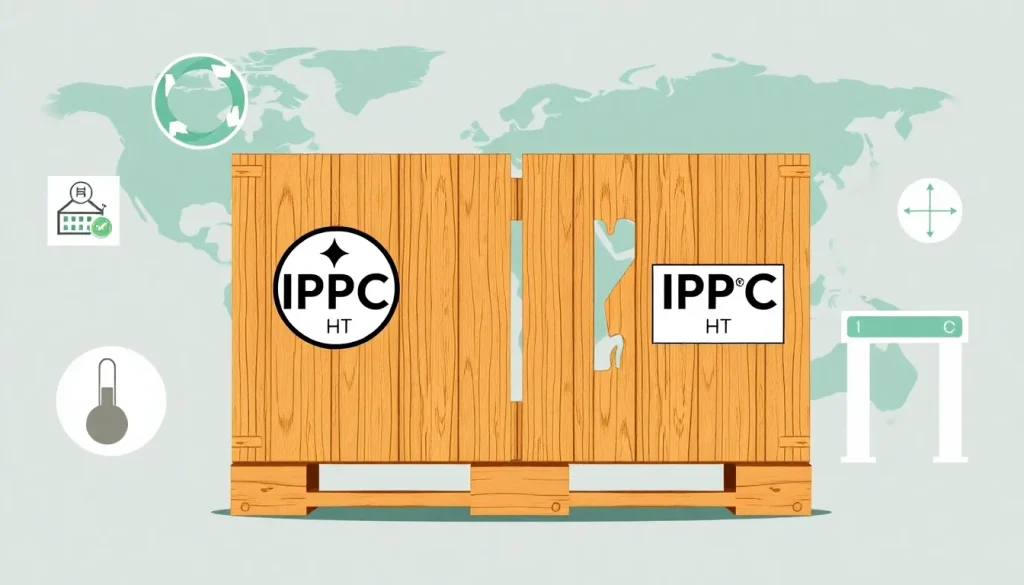
- Marks must be permanent, legible, and placed on at least two opposite faces of each item.
- Records must be retained for a minimum of two years.
- Exemptions (e.g., raw wood, non‑commercial shipments) are limited and must be documented.
Step‑by‑Step Checklist (How‑to Trigger Compliance)
Use this quick reference before loading a container:
- Identify WPM: List every pallet, crate, and dunnage.
- Choose Treatment: Verify that the selected provider is accredited for HT or MB.
- Obtain Treatment Certificate: Ensure temperature logs (HT) or gas concentration data (MB) are attached.
- Apply Marking: Place the IPPC symbol, ISO country code, and treatment code (HT or MB) on at least two opposite sides.
- Example mark: IPPC | US | HT
- Issue Phytosanitary Certificate: Request the NPPO to issue a PC that cites ISPM 15 compliance.
- Compile Shipping Docs: Attach PC, treatment certificate, commercial invoice, and WPM declaration.
- Pre‑load Inspection: Conduct an internal audit; verify mark visibility and document numbers.
- Retain Records: Store digital copies for at least 24 months.
Common Mistakes & Rejection Reasons
Even seasoned exporters stumble over the same pitfalls:
- Missing or illegible IPPC mark: Customs may seize the pallet.
- Using non‑accredited treatment facilities: The PC is invalid.
- Incorrect treatment code: HT marked as MB (or vice‑versa) triggers rejection.
- Exempting raw timber without proper documentation: Leads to quarantine hold.
- Failure to retain records for two years: Audits can result in fines.
Real‑World Example/Scenario
Company GreenLogistics Ltd. exported 500 pallets of fresh mangoes from Mexico to Canada. The pallets were heat‑treated, but the marking was applied only on one side of each pallet. Upon arrival, Canadian CFIA inspected a random sample, found the missing mark, and detained the cargo. The shipment was released only after GreenLogistics provided supplemental photographs proving the treatment, incurring a US$12,000 delay charge.
Key lessons:
- Mark both opposite faces of every pallet.
- Maintain photographic evidence of the mark for the entire shipment.
- Inform the freight forwarder of ISPM 15 requirements during booking.
Conclusion
ISPM 15 is a cornerstone of global plant‑health security. By mastering the treatment methods, marking rules, and documentation requirements, exporters can avoid costly disruptions, and importers can protect domestic agriculture from invasive pests. Use the checklist, keep records, and stay current with NPPO updates to ensure seamless cross‑border movement of goods.
FAQ
Can raw timber be used as wood packaging under ISPM 15?
Only if it has been treated and marked according to ISPM 15. Unprocessed logs or un‑treated raw timber are exempt but must be declared and are subject to inspection.
Is methyl bromide still accepted after the Montreal Protocol restrictions?
Yes, MB remains an approved ISPM 15 treatment, but many countries encourage heat treatment as a less environmentally hazardous alternative.
What should I do if a customs officer finds a missing IPPC mark after shipment?
Provide the original treatment certificate and, if possible, photographic evidence of the mark before loading. If the mark cannot be verified, the pallet may be re‑treated or the shipment delayed pending further inspection.





Leave a Reply