Short Answer
International trade in plants and plant products relies heavily on the phytosanitary certificate, a critical document verifying that shipments meet the plant health requirements of the importing country. Despite its importance, errors in documentation frequently lead to border rejections, resulting in financial loss, destruction of goods, and damaged trade relationships. Understanding the common reasons phytosanitary certificates get rejected and how to prevent them is essential for exporters, importers, and logistics professionals navigating the complex landscape of global agriculture compliance.
Overview
A phytosanitary certificate is an official document issued by the National Plant Protection Organization (NPPO) of the exporting country. It attests that the consignment has been inspected and found free from regulated pests and diseases, complying with the importing country’s phytosanitary import requirements. The document follows a model established by the International Plant Protection Convention (IPPC). While the format is standardized, the specific declarations within the certificate vary based on the commodity and destination. Errors often arise from mismatches between the certificate data, commercial invoices, and the actual physical shipment.
Why It Matters
The stakes for non-compliance are exceptionally high. When a phytosanitary certificate is rejected at the port of entry, the consequences extend beyond simple administrative delays. Importers may face immediate orders for re-exportation or destruction of the cargo at their own expense. Furthermore, repeated violations can lead to increased inspection frequencies, loss of trusted trader status, or even temporary bans on specific exporters. For the exporting country, systemic errors can trigger broader trade restrictions affecting entire industry sectors. Therefore, accuracy in plant health documentation is not merely a bureaucratic hurdle but a fundamental component of biosecurity and economic stability.
Requirements and Standards
The primary authority governing phytosanitary certification is the IPPC, which sets International Standards for Phytosanitary Measures (ISPMs). Specifically, ISPM 12 outlines the requirements for phytosanitary certificates. NPPOs must adhere to these standards to ensure mutual recognition between trading partners. The certificate must be original, signed by an authorized officer, and free from alterations. Any corrections must be stamped and signed by the issuing officer. The language used must be acceptable to the importing country, often requiring English or a specific local language alongside the original text.
“The phytosanitary certificate shall conform to the model certificate set out in Annex 1 to ISPM 12.” – International Standards for Phytosanitary Measures
Required Documents
While the phytosanitary certificate is the core document, it rarely travels alone. Customs and agriculture officials require a cohesive document package to verify the shipment’s legitimacy. Commonly required accompanying documents include:
- Commercial Invoice: Must match the consignor and consignee details on the certificate.
- Packing List: Should align with the quantity and weight declared in the phytosanitary certificate.
- Bill of Lading or Air Waybill: Transport documents must reflect the same shipment dates and routing.
- Import Permit: Many countries require a prior import permit number to be cited on the phytosanitary certificate.
Common Rejection Reasons
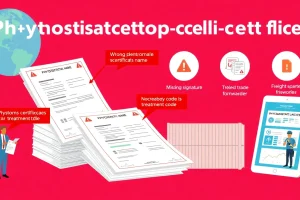
Analysis of border interception data reveals consistent patterns in why shipments are held. The most frequent issues involve data discrepancies and regulatory omissions. Below is a table detailing specific rejection categories and their underlying causes.
| Rejection Category | Specific Cause | Prevention Strategy |
|---|---|---|
| Data Mismatch | Consignee name differs from invoice | Verify all party names across all documents before submission |
| Missing Declarations | Additional declaration code omitted | Check importing country requirements for specific ISPM codes |
| Validity Issues | Certificate issued too early before shipment | Ensure inspection occurs within the valid window (usually 14 days) |
| Alterations | Uncertified corrections on the document | Request re-issuance rather than manual corrections |
Step-by-Step Checklist
To mitigate the risk of rejection, exporters should follow a rigorous validation process before the shipment leaves the facility. This checklist ensures that all compliance bases are covered:
- Verify Import Requirements: Consult the importing country’s NPPO website or the IPPC Phytosanitary Portal for specific commodity rules.
- Inspect Consignment: Ensure the goods are free from visible pests, soil, and prohibited materials prior to inspector arrival.
- Draft Review: Request a draft copy of the phytosanitary certificate from the NPPO for verification.
- Cross-Check Data: Compare the draft against the commercial invoice and packing list for exact matches in weight, quantity, and names.
- Final Issuance: Obtain the original signed certificate and ensure it accompanies the shipping documents.
Real-World Example
Consider a scenario where a exporter ships a container of citrus fruit to a country with strict regulations against Citrus Canker. The exporter obtains a phytosanitary certificate but fails to include the mandatory additional declaration stating the orchard is free from the disease. Upon arrival, the importing agriculture authority identifies the missing declaration. Despite the fruit being healthy, the shipment is non-compliant. The result is a mandatory fumigation treatment at the port, causing a two-week delay and significant cost, or in worse cases, rejection and destruction of the cargo. This example underscores that technical accuracy is as vital as biological safety.
Control and Treatment
Sometimes, rejection can be mitigated if the issue relates to treatable pests rather than documentation errors. If a live pest is found during inspection, the NPPO may require specific treatments such as fumigation, cold treatment, or heat treatment. These measures must be documented on the phytosanitary certificate under the treatment section. Failure to record the treatment dosage, duration, or chemical used correctly will render the treatment invalid in the eyes of the importing authority. Exporters must ensure treatment providers are certified and that the resulting documentation is seamlessly integrated into the final certificate.
Conclusion
Navigating the complexities of phytosanitary certification requires attention to detail and a proactive approach to compliance. By understanding the common reasons phytosanitary certificates get rejected and how to prevent them, trade professionals can safeguard their shipments against costly border interventions. Adherence to IPPC standards, rigorous document verification, and clear communication with NPPOs form the backbone of successful plant health trade. As global biosecurity measures tighten, the value of accurate certification will only increase, making these best practices essential for long-term operational success.
FAQ
How long is a phytosanitary certificate valid?
Validity varies by country, but it is typically valid for 14 days from the date of issuance to the date of export.
Can I correct a mistake on a phytosanitary certificate?
Yes, but corrections must be stamped and signed by the authorized issuing officer; unofficial alterations will cause rejection.
What happens if my certificate is rejected?
The shipment may be held, subjected to mandatory treatment, re-exported, or destroyed at the importer's expense.





Leave a Reply