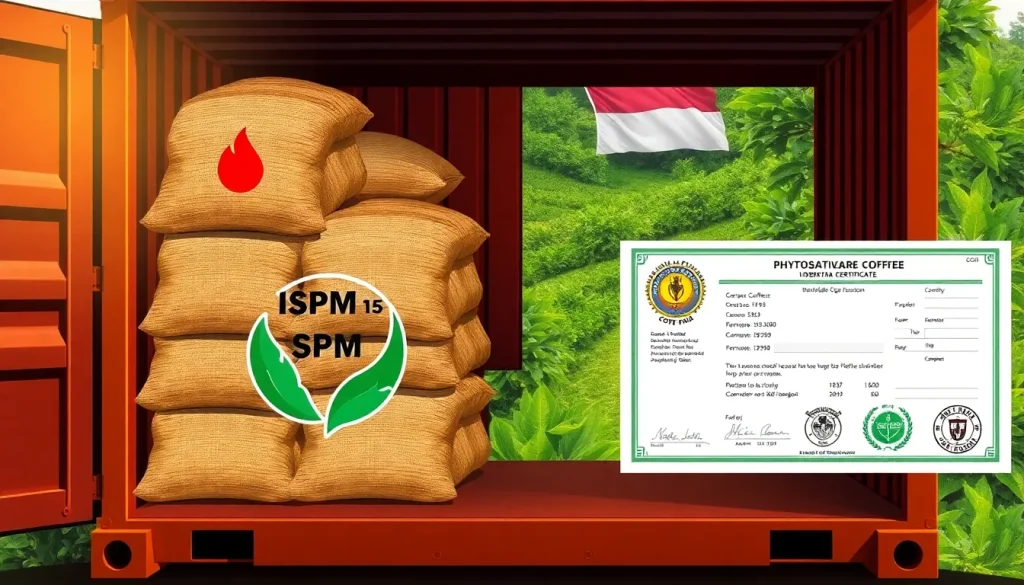
Short Answer
Indonesia ranks among the world’s top producers of both coffee and cocoa, supplying premium beans to markets across Europe, the United States, and Asia. While the commodities themselves meet strict quality standards, each shipment must also satisfy Indonesia’s phytosanitary and customs rules. Failure to comply can trigger costly delays, re‑exports, or outright rejection at the destination port. This pillar article breaks down every requirement— from the responsible authority to the exact documents you need—so that exporters, importers, customs brokers, freight forwarders, and students of plant health can move Indonesian coffee and cocoa with confidence.
Overview
Exporting coffee (Coffea arabica, Coffea canephora) and cocoa (Theobroma cacao) from Indonesia is governed by two parallel frameworks:
- Phytosanitary regulation – overseen by the National Plant Protection Organization (NPPO) of Indonesia, the Direktorat Jenderal Perkebunan (DGPP) under the Ministry of Agriculture.
- Customs and trade regulation – administered by the Directorate General of Customs and Excise (Direktorat Jenderal Bea dan Cukai).
Both sets of rules must be satisfied before a shipment can receive a Phytosanitary Certificate (PC) and a Customs Declaration. The International Plant Protection Convention (IPPC) standard ISPM 15 (for wood packaging) and ISPM 31 (for seed) also apply when relevant.
Why It Matters (Real Stakes for Exporters/Importers)
Non‑compliance can have severe financial and reputational consequences:
- Shipment delays – Average clearance time for non‑conforming coffee can increase from 24 hours to 5‑7 days, incurring demurrage.
- Re‑export costs – Returned cargo must be re‑treated, re‑certified, and re‑shipped, often adding 15‑30 % to the landed cost.
- Market bans – Repeated phytosanitary violations may trigger an import ban for the exporter’s entire registration.
- Brand impact – Premium coffee brands rely on traceability; a phytosanitary breach can damage consumer trust.
Understanding the exact requirements therefore protects revenue and brand integrity.
Regulatory Authority & Contact
The primary agency responsible for issuing phytosanitary certificates for coffee and cocoa is the NPPO of Indonesia, specifically the Plant Quarantine Service (PQS) within the DGPP.
| Agency | Division | Phone | Website | |
|---|---|---|---|---|
| Ministry of Agriculture – DGPP | Plant Quarantine Service | +62‑21‑384‑3988 | pqs@pertanian.go.id | https://www.pertanian.go.id/pqs |
| Directorate General of Customs | Import‑Export Division | +62‑21‑1500‑1520 | customs@customs.go.id | https://www.beacukai.go.id |
Exporters should register with the PQS’s e‑Export System (e‑EXS) to submit applications electronically.
Import/Export Procedure
The end‑to‑end workflow for a coffee or cocoa shipment from Indonesia to an overseas market typically follows these steps:
- Pre‑export inspection – A PQS inspector visits the farm/processing plant to verify pest‑free status.
- Sampling & laboratory analysis – Samples are tested for regulated pests (e.g., Hypothenemus hampei – coffee berry borer) and diseases (e.g., cocoa swollen shoot virus).
- Application for Phytosanitary Certificate – Submit the e‑EXS form together with commercial invoice, packing list, and treatment certificates.
- Issuance of PC – The PQS issues a PC that includes the commodity description, origin, treatment details, and QR code for verification.
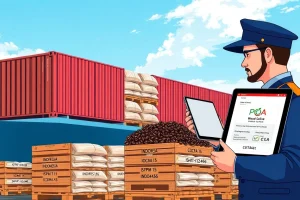
- Customs clearance in Indonesia – Present the PC, commercial documents, and ISPM‑15‑certified wooden pallets to customs.
- Export loading & transport – Load the cargo onto a container that complies with ISPM‑15 standards.
- Destination country clearance – The importing country’s NPPO validates the PC against its own import requirements.
Any deviation—such as missing a laboratory result—will trigger a “hold” at step 3 or step 7.
Required Documents
Exporters must provide a complete dossier. Missing any item is a common cause of rejection.
- Phytosanitary Certificate (original and digital copy)
- Commercial Invoice (showing HS code 0901 for coffee, 1801 for cocoa)
- Packing List (detailing net weight, container number, and packaging type)
- Certificate of Origin (if required by the destination)
- Fumigation / Treatment Certificate (e.g., heat treatment for cocoa beans, if demanded)
- ISPM‑15 Wood Packaging Certificate (Matricula number on pallets)
- Export Declaration (customs form 1.2) submitted through the Indonesian National Single Window (INSW)
All documents should be in English or accompanied by a certified translation.
Requirements & Standards
The baseline standards are set by the IPPC and adopted locally by Indonesia’s NPPO. Key references include:
IPPC (2022). International Standards for Phytosanitary Measures (ISPM) No. 31 – Seed. Rome: FAO.
Indonesia Ministry of Agriculture (2023). Regulation No. 13/2023 on Plant Quarantine for Coffee and Cocoa. Jakarta.
World Trade Organization (2021). Agreement on the Application of Sanitary and Phytosanitary Measures (SPS Agreement).
Key compliance points:
- Pest‑free status: No presence of Hypothenemus hampei, Colletotrichum kahawae, or Moniliophthora roreri in the last 12 months.
- Moisture content: Coffee beans must be ≤12 % moisture; cocoa beans ≤7 % moisture, verified by a calibrated moisture meter.
- Residue limits: Pesticide residues must comply with Codex Alimentarius maximum residue limits (MRLs) for the destination market.
- Packaging: All wooden pallets must carry the ISPM‑15 mark (IPPC‑approved heat‑treated or fumigated).
Step‑by‑Step Checklist (How‑to Trigger a Successful Export)
- Confirm that the farm/processor is registered with the PQS e‑EXS system.
- Schedule a pre‑export inspection at least 10 working days before shipment.
- Collect representative samples (minimum 500 g per batch) for laboratory testing.
- Obtain laboratory results confirming absence of regulated pests/diseases.
- Complete the e‑EXS application, attaching:
- Commercial invoice
- Packing list
- Moisture‑meter certificate
- Residue analysis report (if required)
- Pay the PC issuance fee (IDR 500,000 for coffee, IDR 750,000 for cocoa).
- Receive the PC (valid for 30 days from issuance) and verify QR code data.
- Ensure all wooden packaging bears the ISPM‑15 stamp; obtain the accompanying certificate.
- Submit the Export Declaration via INSW and retain the reference number.
- Load cargo into a sealed container; attach a copy of the PC to the exterior of the container.
- Provide the destination NPPO’s import authority with a digital copy of the PC at least 48 hours before arrival.
Following this checklist reduces the probability of a “hold” at any checkpoint.
Common Mistakes & Rejection Reasons
Even experienced exporters slip up. The most frequent issues are:
- Expired or mismatched PC – Using a certificate older than 30 days or for a different batch.
- Incorrect HS code – Mis‑classifying roasted coffee as “other” (HS 0902) triggers a different tariff and PC requirement.
- Missing ISPM‑15 mark – Wooden pallets without the heat‑treatment symbol are seized.
- Undeclared pesticide residues – Importing countries (EU, US) reject shipments exceeding Codex MRLs.
- Inadequate sample size – Labs reject samples that do not meet the minimum weight, delaying certification.
Addressing these pitfalls early saves time and money.
Real‑World Example/Scenario
Scenario: An Indonesian exporter ships 20 MT of washed Arabica beans to the Netherlands. The shipment is held at Rotterdam Airport because the wooden pallets lack the ISPM‑15 heat‑treatment stamp.
Resolution steps:
- The exporter contacts the Dutch NPPO, which requests proof of treatment.
- The exporter arranges a re‑treatment of the pallets in Jakarta, obtains a new ISPM‑15 certificate, and forwards it to the Dutch authority.
- The pallets are re‑loaded onto the same container; the PC is re‑issued (no new lab tests needed because the commodity itself is unchanged).
- After 48 hours, the Dutch customs release the cargo, and the exporter incurs an additional US$4,200 in re‑handling fees.
This example illustrates why compliance with packaging standards is as critical as the phytosanitary health of the beans.
Conclusion
Exporting coffee and cocoa from Indonesia demands meticulous coordination between plant health authorities, customs, and logistics partners. By adhering to the IPPC‑derived standards, securing a valid phytosanitary certificate, and following the step‑by‑step checklist, exporters can avoid costly delays and maintain market access. Keep this guide handy, double‑check each document, and stay current with any regulatory updates issued by the Indonesian NPPO.
| Fact | Detail |
|---|---|
| NPPO Authority | Direktorat Jenderal Perkebunan – Plant Quarantine Service |
| Key ISPM Standards | ISPM‑15 (wood packaging), ISPM‑31 (seed), ISPM‑36 (pesticide residues) |
| PC Validity | 30 days from issuance for coffee & cocoa |
| Typical Inspection Lead Time | 7‑10 working days before shipment |
| Primary Regulated Pests | Hypothenemus hampei, Moniliophthora roreri, Colletotrichum kahawae |
FAQ
How long does a Phytosanitary Certificate remain valid for coffee exports from Indonesia?
The PC is valid for 30 calendar days from the date of issuance. Exporters must ship the consignment within this period, otherwise a new certificate is required.
Do roasted coffee beans require a phytosanitary certificate?
Yes. Even roasted beans are considered a plant product under IPPC rules and must be accompanied by a PC confirming they are pest‑free and meet moisture limits.
What is the penalty for using pallets without the ISPM‑15 mark?
Pallets lacking the ISPM‑15 stamp are seized, and the shipment may be held or returned. The exporter is responsible for re‑treatment, replacement of pallets, and any associated demurrage fees.





Leave a Reply