
Short Answer
International trade of plant products is a cornerstone of the global economy, but it also carries the risk of moving pests and diseases across borders. The Phytosanitary Certificate of Treatment (PCT) is the official document that proves a consignment has undergone an approved treatment—such as heat, fumigation, or irradiation—and meets the importing country’s phytosanitary standards. For exporters, completing a PCT accurately is essential to avoid costly delays, re‑inspection, or outright rejection at the border.
Overview
A Phytosanitary Certificate of Treatment (PCT) is issued by the National Plant Protection Organization (NPPO) of the exporting country. It certifies that the commodity listed in the certificate has been treated according to the specific method and parameters required by the importing country’s phytosanitary regulations. The PCT is separate from a standard Phytosanitary Certificate (PC) that confirms the absence of pests; the PCT focuses on the treatment itself.
Why It Matters (Real Stakes for Exporters/Importers)
Failure to provide a valid PCT can lead to:
- Shipment detention or diversion – cargo may be held at the port of entry until the issue is resolved.
- Financial loss – storage fees, re‑treatment costs, and potential loss of market reputation.
- Regulatory penalties – fines imposed by customs or plant‑health authorities.
- Supply‑chain disruption – delayed delivery can breach contracts with downstream buyers.
For importers, an invalid PCT can result in the entry of regulated pests, leading to quarantine measures that affect domestic agriculture.
Regulatory Authority & Contact
The authority that issues a PCT varies by country, but it is always the NPPO or a delegated agency. Below is a typical contact hierarchy:
| Role | Typical Agency | Contact Point |
|---|---|---|
| National Plant Protection Organization (NPPO) | Ministry of Agriculture / Plant Health Service | Plant Health Hotline – 1‑800‑PH-HELP |
| Regional Phytosanitary Office | State/Provincial Plant Quarantine Office | email: phytosanitary@regional.gov |
| Designated Treatment Facility | Accredited Fumigation/Heat Treatment Provider | phone: 555‑123‑4567 |
Exporters should obtain the exact name and email of the NPPO officer responsible for PCT issuance to streamline communication.
Requirements & Standards
The PCT must comply with international standards set by the International Plant Protection Convention (IPPC) and the specific importing‑country requirements. Key references include:
- IPPC Standard ISPM 15 – Governs wood packaging material treatments (heat or methyl bromide).
- IPPC Standard ISPM 20 – Provides guidelines for the format and content of phytosanitary certificates, including PCTs.
- Importing Country’s NPPO Regulations – Often published as a “Pest‑Specific Treatment Standard” (e.g., USDA APHIS 7 CFR 319 for the United States).
“A Phytosanitary Certificate of Treatment shall contain, at a minimum, the name of the treatment, the method applied, the parameters (temperature, duration, chemical concentration, etc.), and the name and accreditation number of the treatment facility. – ISPM 20, Annex II”
Key data elements required on the PCT include:
- Exporter’s name and address.
- Consignee’s name and address.
- Commodity description (common name, scientific name, HS code).
- Origin and destination countries.
- Treatment type (heat, fumigation, irradiation, cold).
- Specific treatment parameters (e.g., 56 °C for 30 min).
- Accreditation number of the treatment facility.
- Signature and seal of the NPPO official.
Step‑by‑Step Checklist (How to Trigger a PCT)
Follow this checklist to ensure your PCT is complete before the cargo leaves the export country:
- Confirm Treatment Requirement: Verify the importing country’s phytosanitary import requirements for the commodity.
- Select an Accredited Facility: Choose a treatment provider listed on the NPPO’s accredited list.
- Schedule Treatment: Provide the facility with the shipment details (weight, packaging, commodity).
- Obtain Treatment Record: After treatment, collect the official log showing temperature, time, and chemical dosage.
- Prepare Draft PCT: Use the NPPO’s template (often available online) and fill in all mandatory fields.
- Submit Supporting Documents: Attach the treatment record, commercial invoice, packing list, and any phytosanitary permits.
- NPPO Review: The NPPO officer verifies the treatment data against the importing country’s standards.
- Certificate Issuance: Once approved, the NPPO signs, stamps, and issues the PCT (usually in duplicate).
- Attach PCT to Shipment: Affix one original to the export documents and retain the second for the importer’s records.
- Notify Consignee: Send a scanned copy of the PCT to the importer and the freight forwarder.
Completing each step in order reduces the risk of rejection at the border.
Required Documents
In addition to the PCT itself, exporters must provide the following paperwork:
- Commercial invoice (detailing value, HS code, and country of origin).
- Packing list (showing container numbers and commodity weight).
- Phytosanitary Certificate (standard PC) if required by the destination.
- Treatment record or log sheet signed by the accredited facility.
- Import permit issued by the destination NPPO (when applicable).
- Export license or phytosanitary permit from the exporting NPPO.
Common Mistakes & Rejection Reasons
Even experienced exporters stumble over a few recurring errors:
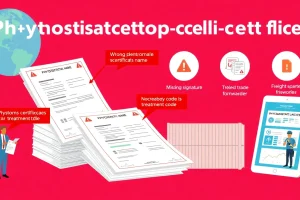
| Mistake | Typical Rejection Reason |
|---|---|
| Incorrect treatment parameters | Does not meet importing country’s minimum temperature/time or chemical concentration. |
| Missing accreditation number | NPPO cannot verify that the facility is approved. |
| Wrong commodity scientific name | Regulatory mismatch leading to pest‑risk assessment failure. |
| Omitted signature or seal | Certificate considered unofficial. |
| Using an outdated NPPO template | Form fields do not align with current ISPM 20 requirements. |
To avoid these pitfalls, always double‑check the latest NPPO guidance and keep a master checklist on hand.
Real‑World Example/Scenario
Imagine a U.S. exporter shipping fresh mangoes to the European Union. The EU requires a heat treatment of 52 °C for at least 30 minutes to mitigate the risk of Carposina sasakii. The exporter follows these steps:
- Contacts the EU’s NPPO website to confirm the treatment standard (Regulation (EU) 2019/2072).
- Books an accredited heat‑treatment facility in California, obtaining the facility’s accreditation number (US‑HT‑0012).
- After treatment, receives a log showing 53.2 °C sustained for 32 minutes.
- Fills out the PCT template, entering the exact temperature, duration, and facility number.
- Attaches the treatment log, commercial invoice, and phytosanitary permit, then submits to the USDA APHIS Plant Protection Office.
- APHIS issues the PCT, which the exporter includes in the export packet.
- At the EU border, customs scans the PCT; the data matches the EU requirement, and the cargo is released without delay.
This scenario illustrates how precise documentation aligns with both IPPC standards and the importing country’s specific rules, preventing costly hold‑ups.
Conclusion
Completing a Phytosanitary Certificate of Treatment correctly is a critical step in the export of regulated plant commodities. By understanding the regulatory framework, assembling the required documents, and following a disciplined step‑by‑step checklist, exporters can safeguard their shipments against unnecessary delays and maintain market access. Remember that the PCT is a living document—always verify the latest import requirements, keep communication lines open with the NPPO, and treat the certificate as an integral part of your export compliance program.
FAQ
Can I issue a PCT myself as a private exporter?
No. Only an authorized officer of the NPPO may sign and stamp a Phytosanitary Certificate of Treatment. Private parties can only provide treatment records for the NPPO’s review.
How long is a Phytosanitary Certificate of Treatment valid?
Validity periods vary by importing country, but most PCTs are valid for 30 days from the date of issue unless a shorter period is specified in the destination’s regulations.
What if the treatment parameters differ slightly from the standard?
Any deviation must be pre‑approved by the importing country’s NPPO. Without prior approval, the certificate will be rejected for non‑compliance.




Leave a Reply